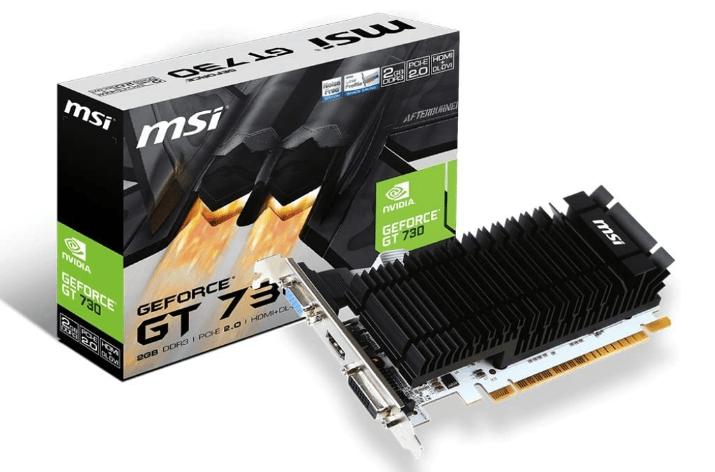
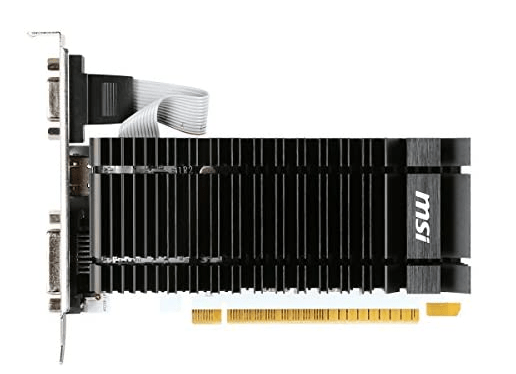
The GeForce GT 730 graphics card was first released by Nvidia on June 18, 2014. Micro-Star International, Nvidia's Taiwanese partner manufacturer, also released its cards under its MSI brand. This card is available online for approximately €60.

GeForce GT 730 graphics card specifications
The GeForce GT 730 is an entry-level Nvidia graphics card. It operates at 902 MHz under normal use. The card is based on the Fermi architecture . This card features 2 GB of DDR3 memory running at 1.8 GHz . It transfers data on a 128-bit bus with a bandwidth of 25.6 Gb/s . It has a PCIe 2.0 x16 interface for installation on the motherboard. The GT 730 measures 6.9 x 3.8 x 14.6 centimeters and weighs approximately 300 grams.
The card features three video outputs: one VGA, one HDMI, and one DVI. This allows it to be used to upgrade PCs that only have a VGA output. The upgraded PC can then be connected to newer devices with DVI or HDMI video inputs. The GT 730 is a low-profile card, making it compatible with virtually any PC currently on the market.

GeForce GT 730 graphics card performance
The GeForce GT 730 features 96 shader processors and 585 million transistors 40-nanometer process and has 96 CUDA cores . This card has a TDP of 49 watts . The minimum recommended power power supply the PC housing the GT 730 would therefore be 300 watts. For texture rendering speed, the GT 730 transfers 11.2 GT/s . For comparison, the brand-new Radeon RX 6900XT transfers data at 771.2 GT/s. The GT 730 processes 268.8 GFLOPS of floating-point processing. This card supports the following features and APIs: DirectX 12, Shader 5.1, OpenGL 4.6, OpenCL 1.1, and CUDA 2.1
MSI is well-known for its high-quality components. The capacitors have a lifespan of approximately 10 years. The MSI GT 730 is quiet thanks to its well-designed cooling system. The substantial heatsink running the length of the card prevents the GPU and memory from overheating, resulting in a lower ESR. The GT 730 offers a maximum analog resolution of 2048 x 1536 and a maximum digital resolution of 2560 x 1600. It can support two displays simultaneously.
The hardware limitations of the GT 730 are overcome by the various software features supported by the card to boost its performance. The card notably supports Microsoft DirectX 12, NVIDIA 3D Vision Ready, NVIDIA Adaptive Vertical Sync, NVIDIA CUDA Technology with OpenCL support, NVIDIA FXAA Technology, NVIDIA PhysX Technology, NVIDIA PureVideo HD Technology, NVIDIA TXAA Technology…
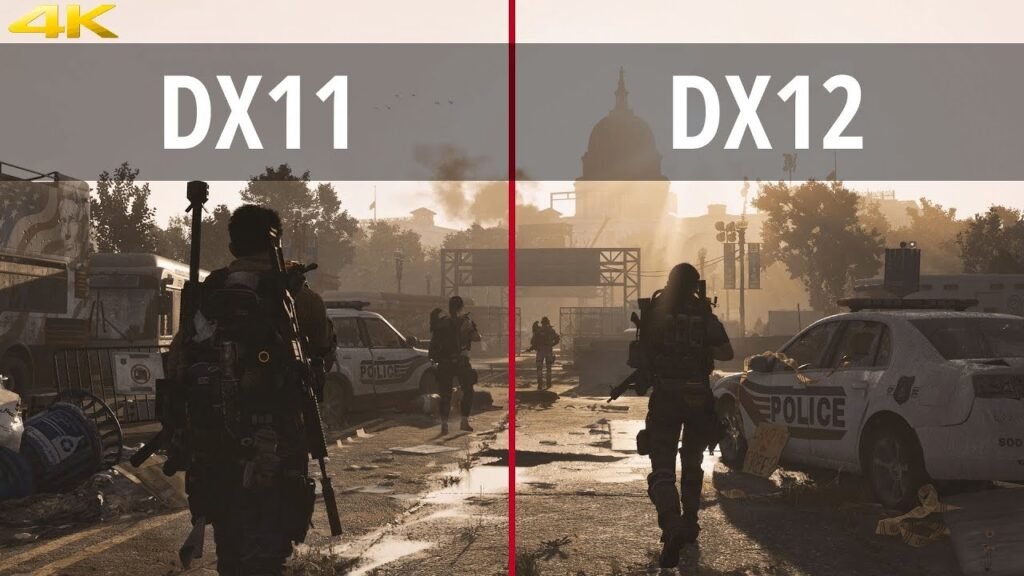
DirectX 12 enables multitasking of graphics instructions. With DirectX 11, graphics tasks were grouped on a single CPU core, resulting in significant processing latency. In contrast, with DirectX 12, graphics tasks can be distributed across multiple CPU cores, making processing faster and smoother.
NVIDIA 3D Vision Ready allows the card to support stereoscopic 3D displays and glasses. As a result, the card delivers a smooth, tear-free Full HD resolution, much to the delight of 3D gamers.
The GT 730 supports NVIDIA Adaptive Vertical Sync . When enabled, it prevents stuttering and image tearing in the output. We typically see stuttering when the frame rate is low enough and tearing at high FPS. Adaptive Vertical Sync activates V-Sync when the frame rate is too high to prevent image tearing and deactivates it when the frame rate is too low to provide smooth images.
NVIDIA FXAA Technology ensures minimal processing time by using a post-processing shader that analyzes images and only processes sufficiently different areas. It is NVIDIA's anti-aliasing system, in response to AMD's MLAA. The GT 730 also supports TXAA , which reduces flicker. It effectively handles anti-aliasing but consumes more power.
PhysX allows you to take advantage of a physics engine that provides realistic effects. It's a processing engine originally created by AGEIA but acquired by Nvidia in 2008. It also allows the 96 CUDA cores of the GT 730 to handle certain calculations, thus relieving the CPU of some workloads. The CPU can then handle other, more demanding tasks. This results in greater efficiency and prevents system overload. PhysX is indeed supported by cards like the GT 730, which have more than 32 CUDA cores and 256 MB of memory.

GeForce GT 730 benchmarking
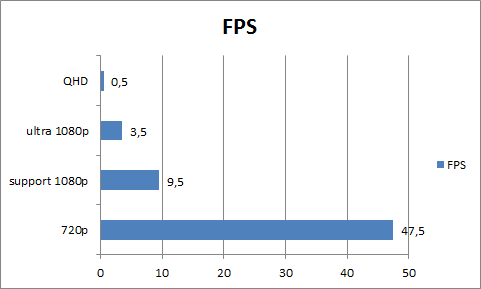
In Fortnite, the GT 730 manages to deliver a frame rate of 47.5 FPS at 720p . However, if you increase the output resolution, the GT 730 reaches its limits. At 1080p Ultra, we get 3.5 FPS, and at QHD, the average frame rate is around 0.5 FPS. This card can therefore be used at 720p resolution and below. It is not recommended for playing above this resolution, as you will experience less smooth or even choppy visuals.
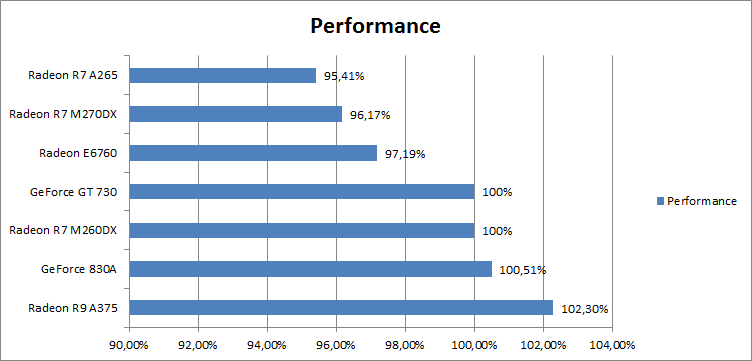
Comparing the GT 730 with cards of the same generation, we find that it sits between the Radeon E6760 and the Radeon R7 M260DX. The latter offers performance equivalent to the GT 730, while the Radeon E6760 lags behind by 2.8%.
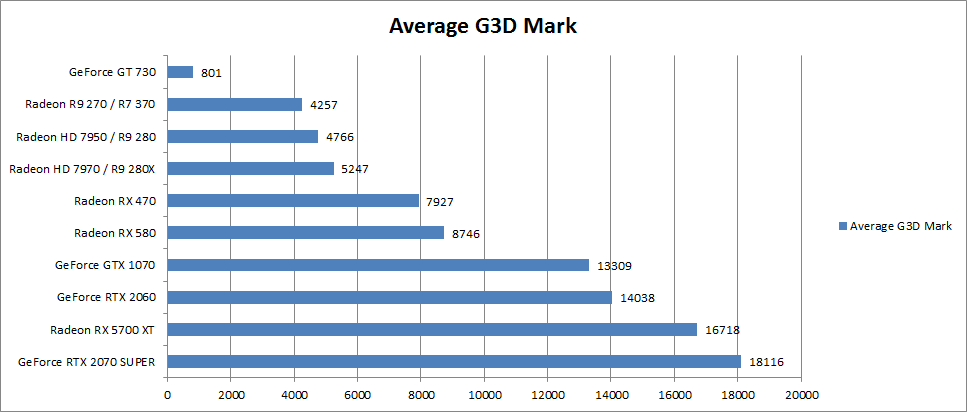
On 3GDMark , the GeForce GT 730 graphics card scores 801. This is relatively low compared to the other cards tested. To give you an idea of its performance, the Radeon R7 370 scores 4,257, and the Radeon R9 280 scores 4,776. More recent cards such as the Radeon RX 5700 XT and the GeForce RTX 2070 Super score 16,718 and 18,116 respectively.
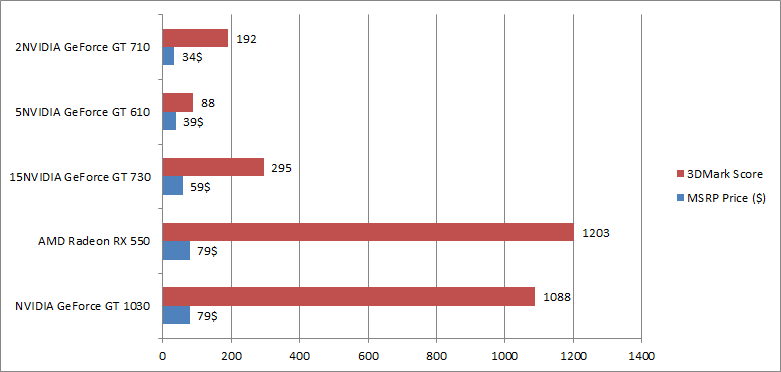
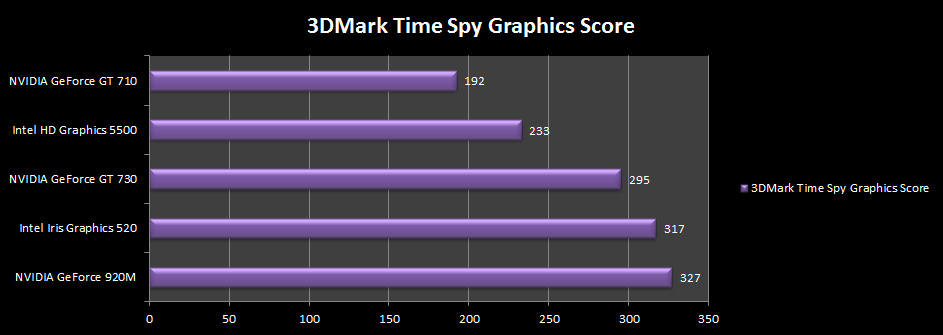
When testing the GeForce GT 730 on 3DMark , it obtained a score of 295. Cards with a similar score are the NVIDIA GeForce GT 710 (3DMark score 192), the Intel HD Graphics 5500 (3DMark score 233), the Intel Iris Graphics 520 (3DMark score 317) and the NVIDIA GeForce 920M (3DMark score 327).
If we now compare the cards with similar initial manufacturer's suggested retail prices (MSRP) and their respective 3DMark scores, the GT 730 outperforms the GeForce GT 710 (3DMark score 192) and the GT 610 (3DMark score 88). However, it falls far short of the AMD Radeon RX 550 (3DMark score 1203) and the NVIDIA GeForce GT 1030 (3DMark score 1088).