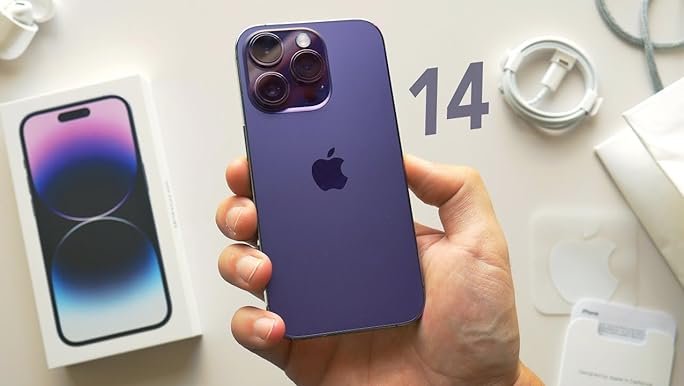
The iPhone 14 Pro is the latest addition to Apple's high-end smartphone lineup. It stands out for its elegant design, high performance, and above all, its innovative camera.
Equipped with a 48-megapixel main sensor, a 12-megapixel ultra-wide-angle lens, a 12-megapixel telephoto lens, and Dynamic Island, it promises to capture images and videos of exceptional quality.
But is it really the best smartphone for photography and video enthusiasts?
A 48-megapixel main sensor that makes all the difference
The iPhone 14 Pro is Apple's first smartphone to feature a 48-megapixel . This sensor, larger than the one in the iPhone 14 (12 megapixels), allows it to capture more detail and light, especially in low light.
It also benefits from Deep Fusion technology , which combines multiple images to optimize sharpness, contrast, and colors.
The result is impressive: photos taken with the iPhone 14 Pro are more detailed, more accurate and more dynamic than those taken with the iPhone 14. They rival those of the Samsung Galaxy S23 Ultra , which also has a 48-megapixel sensor, but which tends to saturate colors and smooth textures.
They surpass those of the Xiaomi Mi 12 Ultra, which, despite its 108-megapixel sensor, produces noisy and blurry images.
A versatile ultra-wide-angle and telephoto lens
The iPhone 14 Pro also features a 12-megapixel ultra-wide camera , which allows you to capture landscapes or group scenes with a 120-degree field of view .
This sensor offers good image quality, with little distortion and good exposure control. It is comparable to that of the iPhone 14, which has the same sensor, but it stands out for its macro photography capabilities .
Thanks to Dynamic Island, the iPhone 14 Pro can get as close as 2 cm to its subject and capture minute details , such as the veins of a leaf or the hairs of an insect. This is a unique feature that neither the Samsung Galaxy S23 Ultra nor the Xiaomi Mi 12 Ultra offer.
The iPhone 14 Pro also features a 12-megapixel telephoto lens, allowing for up to 3x zoom without loss of quality . This sensor offers good sharpness and color reproduction, but it struggles in low light, losing sharpness and contrast.
It is superior to that of the iPhone 14, which does not have a telephoto lens, but it is inferior to that of the Samsung Galaxy S23 Ultra, which offers up to 10x optical zoom and up to 100x digital zoom.
It also lags behind that of the Xiaomi Mi 12 Ultra, which offers up to 5x optical zoom and up to 120x digital zoom.
This article about the iPhone 14 Pro might interest you : Everything you need to know about the iPhone 14 Pro's always-on display
A Dynamic Island that revolutionizes the selfie
The iPhone 14 Pro is Apple's first smartphone to feature a Dynamic Island camera, a cutout in the screen that houses the front-facing camera. This 12-megapixel camera allows for high-quality selfies with excellent detail, color, and brightness.
It is distinguished above all by its ability to do portrait mode, which blurs the background to highlight the subject.
Thanks to Dynamic Island, portrait mode works even in low light , which was not the case with the iPhone 14, which had a wider notch.
The iPhone 14 Pro's portrait mode is also more effective than that of the Samsung Galaxy S23 Ultra and the Xiaomi Mi 12 Ultra, which tend to poorly outline hair or ears.
A benchmark 4K video at 60 fps
The iPhone 14 Pro is also an excellent smartphone for video. It can shoot 4K video at 60 frames per second , with optical and digital stabilization, fast and accurate autofocus, and stereo sound. Videos are smooth, sharp, and well-exposed, with natural colors and good contrast.
The iPhone 14 Pro also stands out thanks to its Cinematic Mode , which allows for real-time depth-of-field effects by shifting the focus point from one subject to another. This innovative feature gives videos a cinematic look.
The iPhone 14 Pro thus surpasses the iPhone 14, which does not offer Cinematic Mode, but also the Samsung Galaxy S23 Ultra and the Xiaomi Mi 12 Ultra, which have inferior video performance, particularly in terms of stabilization, focus and color rendering.
Why buy the iPhone 14 Pro from Pixmania?
If you're interested in the iPhone 14 Pro , you can buy it from Pixmania, the online tech specialist. Pixmania offers you many advantages, such as:
- The best price: Pixmania guarantees you the lowest price on the market, thanks to its system of comparison and negotiation with suppliers.
- Fast delivery: Pixmania delivers your iPhone 14 Pro in 24 hours, free of charge or at a reduced price, depending on the delivery method chosen.
- After-sales service: Pixmania supports you throughout the life of your iPhone 14 Pro, with a 2-year warranty, technical assistance and customer service available 7 days a week.
- Trade-in of your old device: Pixmania offers to take back your old smartphone, whatever its condition, and offer you a voucher or a bank transfer in exchange.
- Protecting your iPhone 14 Pro: Pixmania offers you the option to subscribe to Pixcare, a service that protects you against breakage, theft or loss of your iPhone 14 Pro, with fast compensation and no excess.
Comparative table
If you're interested in knowing whether the iPhone 14 Pro is the best smartphone for photos and videos, here's a comparison chart with the iPhone 14 and its main competitors:
| Characteristic | iPhone 14 Pro | iPhone 14 | Samsung Galaxy S23 Ultra | Xiaomi Mi 12 Ultra |
|---|---|---|---|---|
| Main sensor | 48 MP, f/1.78 | 12 MP, f/1.5 | 48 MP, f/1.8 | 108 MP, f/1.9 |
| Ultra wide angle | 12 MP, f/2.2, macro | 12 MP, f/2.4 | 12 MP, f/2.2 | 20 MP, f/2.2 |
| Telephoto Lens | 12 MP, f/2.8, 3x zoom | None | 12 MP, f/3.0, 10x zoom | 48 MP, f/4.1, 5x zoom |
| Front camera | 12 MP, f/1.9, Dynamic Island, Night Portrait mode | 12 MP, f/1.9, notch | 40 MP, f/2.2, hole in the screen | 20 MP, f/2.2, hole in the screen |
| Video | 4K at 60 fps, Cinematic Mode, ProRAW | 4K at 60 fps | 4K at 60 fps, 8K at 24 fps | 4K at 60 fps, 8K at 30 fps |
Conclusion
The iPhone 14 Pro is undoubtedly Apple's best smartphone for photos and videos. It delivers exceptional image quality, thanks to its 48-megapixel main sensor, versatile ultra-wide lens, high-performance telephoto lens, and innovative Dynamic Island. It also stands out with exclusive features like macro photography, Night mode, Cinematic mode, and ProRAW format.
It thus outperforms the iPhone 14, which has a more limited camera.