
An NT Service/Sage Server account Windows services to run on a Sage server. This account has limited rights and privileges, which enhances system security . It does not require a password and is managed automatically by the system.
The NT Service \ Sage Server account is used by the following services:
- The Sage 100cloud Commercial Management service
- The Sage 100cloud Accounting service
- The Sage 100cloud Payroll service
- The Sage 100cloud Fixed Assets service
- The Sage 100cloud Payment Methods service
- The Sage 100cloud Treasury service
- The Sage 100cloud CRM service
To configure the NT Service \ Sage Server account , you must follow these steps:
Step 1: Create the NT Service \ Sage Server account
To create the NT Service\Sage Server account , you must log in to the Sage server with an administrator account Windows Services management console . To do this, click on the Start , then on Run , and type services.msc.
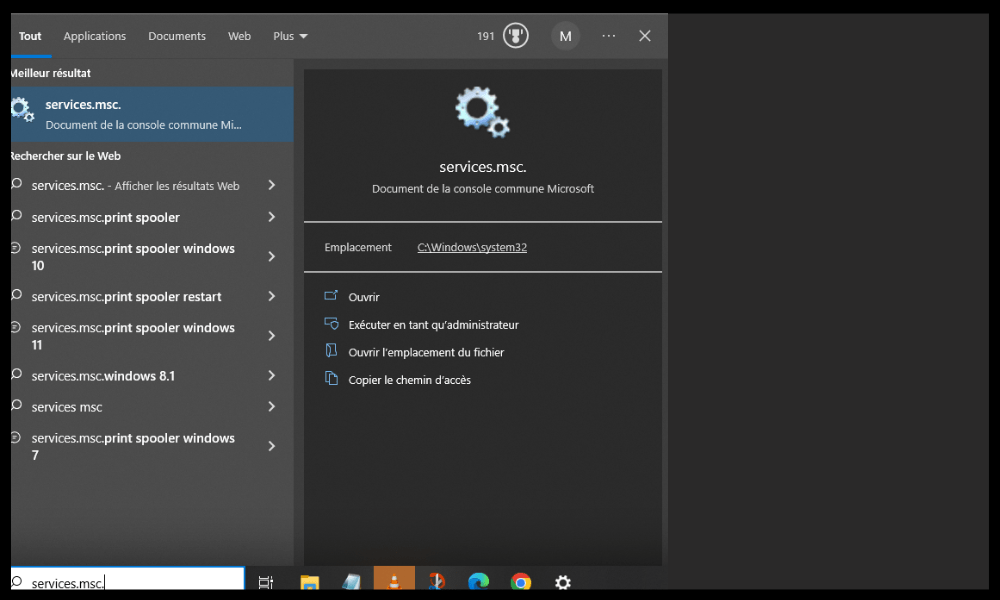
In the Windows Services management console , click on the Action , then on New service. A window will then open for you to enter the information for the new service.
The following fields must be completed:
- Name : you must enter the name of the service corresponding to the Sage software used, for example Sage 100cloud Commercial Management.
- Display name : you must enter the same name as the previous field.
- Description : You need to enter a description of the service, for example Service enabling the execution of the Sage 100cloud Commercial Management software.
- Startup type : Automatic must be selected so that the service starts when the server starts.
- Service type : you must choose Clean Win32 service (shared) so that the service is isolated from other services.
- Executable path : you must enter the path to the executable file of the Sage software, for example C:\Program Files\Sage\Gestion Commercial\GCW.exe.
- Account name : you must enter NT Service\ followed by the name of the service, for example NT Service\Sage 100cloud Gestion Commerciale.
- Password : This field should be left blank, as the NT Service account does not require a password.
Next, click on Next, then on Finish to create the service.
Step 2: Assign rights to the NT Service \ Sage Server account
To assign rights to the NT Service\Sage Server account , you must log in to the Sage server with an administrator account and open the Local Security Policy Management Console. To do this, click on the Start , then on Run , and type secpol.msc .
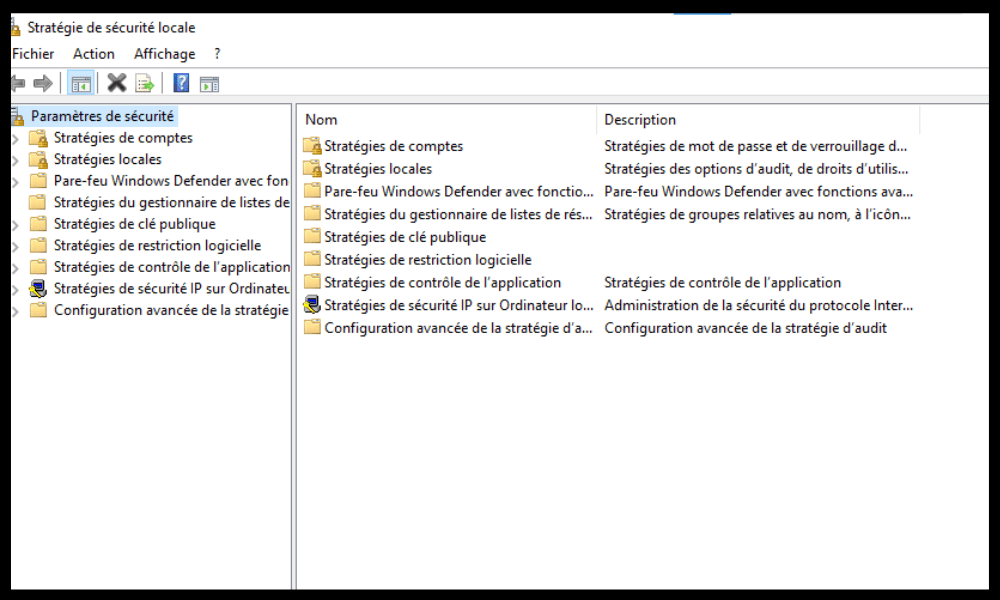
In the Local Security Policy Management Console, click on Local Policies , then on User Rights Assignment . A list of rights will then appear in the right-hand pane of the window.
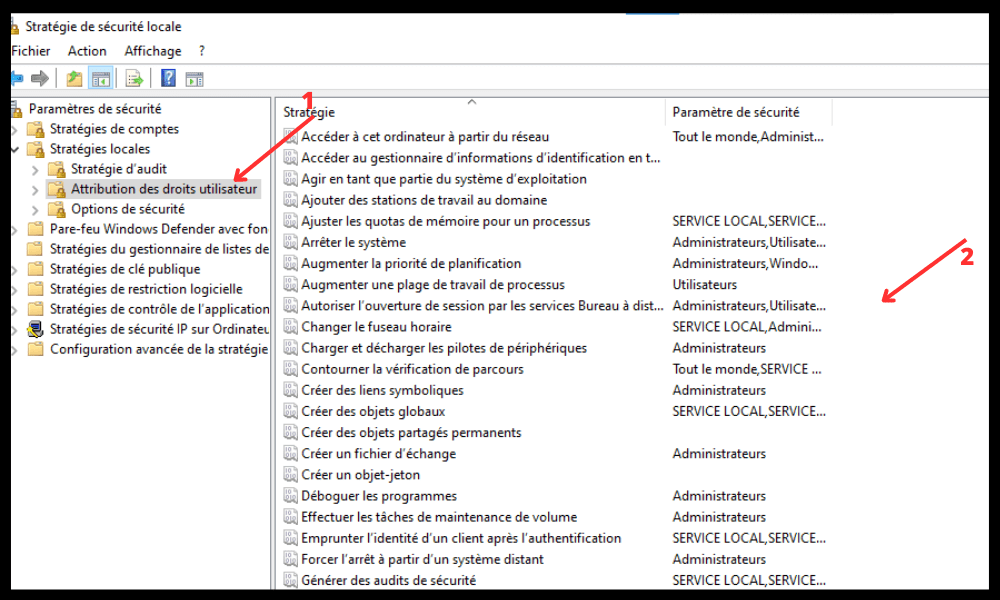
The following rights must be assigned to the NT Service \ Sage Server account:
- To log in as a service: double-click on this right, then click Add user or group . A window will open where you can enter the account name. Type NT Service\ followed by the service name, for example , NT Service\Sage 100cloud Gestion Commerciale , then click OK . Next, click Apply, then OK to confirm the permission.
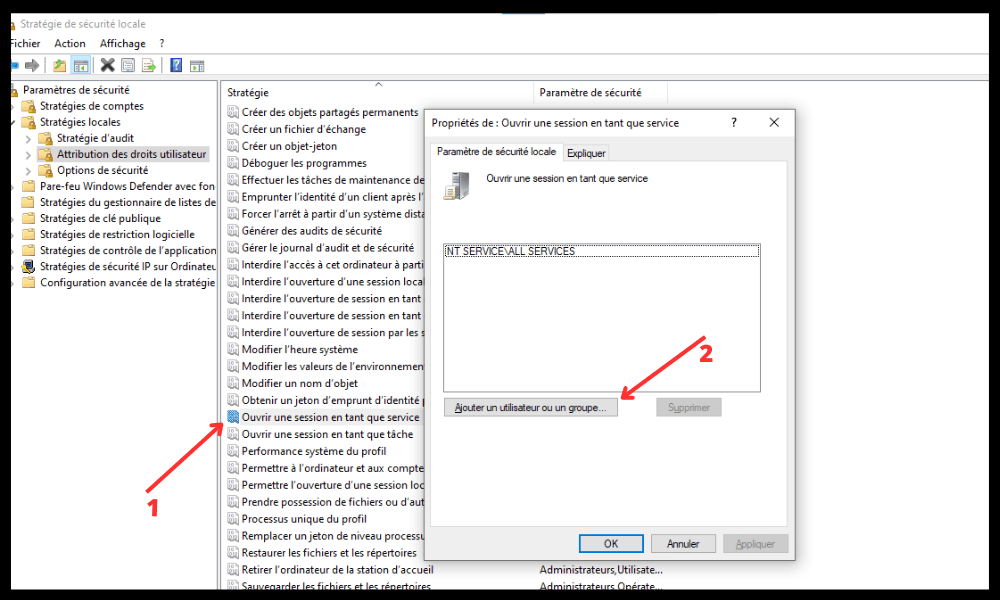
- the same operation must as for the previous right.
- Accessing this computer from the network : you must repeat the same operation as for the previous right.
Step 3: Start the service
To start the service , you must log in to the Sage server with an administrator account Windows Services management console . To do this, click on the Start , then on Run , and type services.msc.
Windows Services console , click on the name of the service corresponding to the Sage software you are using , for example, Sage 100cloud Commercial Management . Then click the Start to launch the service.
The NT Service \ Sage Server account is then configured and the service is operational.
FAQ
Here are some frequently asked questions about the NT Service \ Sage Server account:
How do I change the password for the NT Service \ Sage Server account?
The NT Service \ Sage Server account does not require a password and is managed automatically by the system. Therefore, it is not possible to change its password.
How do I delete the NT Service \ Sage Server account?
To remove the NT Service\Sage Server account, you must stop and delete the service corresponding to the Sage software being used. Then, you must remove the rights assigned to the NT Service\Sage Server account in the Local Security Policy Management Console.
How can I tell if the NT Service \ Sage Server account is correctly configured?
To know if the NT Service \ Sage Server account is correctly configured, you must check that the service corresponding to the Sage software used is started and that there are no errors in the event viewer.
What is the difference between an NT Service \ Sage Server account and a local account or a domain account?

An NT Service/Sage Server account is a type of account specific to Windows that has limited rights and privileges. A local account or a domain account is a standard type of account that can be used to log on to a computer or network. It has more extensive rights and privileges.
What are the risks if I don't use an NT Service\Sage Server account to run Windows services on a Sage server?
If you do not use an NT Service\Sage Server account Windows services on a Sage server, you may encounter security, performance, or compatibility issues. For example, if you use a local or domain account, you may compromise system security by exposing the account password. If you use a local system or network system account, you may affect service performance or compatibility by granting it excessive rights or privileges.
How can I make multiple Windows services use the same NT Service \ Sage Server account?
To allow multiple Windows to use the same NT Service\Sage Server account, you must create a single service with the generic name NT Service\Sage 100cloud and associate it with all the executable files of the Sage software used. Then, you must grant the necessary permissions to the NT Service\Sage 100cloud account in the Local Security Policy Management Console.
How can I make multiple Sage servers use the same NT Service \ Sage Server account?
To allow multiple Sage servers to use the same NT Service\Sage Server account, you must create a local group on each Sage server and add the NT Service\Sage 100cloud account . Then, you must assign the necessary permissions to the local group in the Local Security Policy Management Console.
Can I use an NT Service \ Sage Server account to run Windows services other than those related to Sage software?

No, you cannot use an NT Service \ Sage Server account to run any Windows other than those related to Sage software.
The NT Service\Sage Server account is specific to Windows related to Sage software. It cannot be used to run other Windows unrelated to Sage. Attempting to use an NT Service\Sage Server account for another Windows may result in errors or malfunctions.
What are the advantages and disadvantages of the NT Service / Sage Server account?
The advantages of the NT Service \ Sage Server account are as follows:
- It strengthens system security by limiting the rights and privileges of the service.
- It simplifies service management by not requiring a password or manual intervention.
- It ensures the service's compatibility with different versions of Windows.
The disadvantages of the NT Service \ Sage Server account are as follows:
- It can be difficult to identify and control in cases where multiple services use the same NT Service \ Sage Server account.
- It may be incompatible with certain software or devices that require specific rights or privileges.
How to resolve problems related to the NT Service \ Sage Server account?
To resolve issues related to the NT Service \ Sage Server account , the following points need to be checked:
- The account name NT Service \ Sage Server is correct and matches the service name.
- The path to the Sage software executable is correct and corresponds to the executable file.
- The rights assigned to the NT Service \ Sage Server account are sufficient and appropriate for the service.
- The service has started up and is working correctly.
If the problem persists, you should contact Sage technical support for assistance.
Where can I find more information about the NT Service \ Sage Server account?
You can find more information about the NT Service/Sage Server account on the official Sage website, in the Help and Documentation section. You can also consult forums and blogs specializing in Sage software, where you can exchange information with other users or experts.
Conclusion
The NT Service\Sage Server Windows services on a Sage server. It offers advantages in terms of security and simplicity. To configure it, you must create the service, assign permissions, and start the service . This allows the Sage software to function correctly on the server. To secure your file transfers with FTPS on Windows Server , you can use the SSL/TLS protocol, which encrypts the data exchanged between the client and the server. This protocol is compatible with the NT Service\Sage Server account and allows you to protect your sensitive information.