
Regardless of how you use your computer, it is very important to have a screen with an integrated webcam.
Whether it's for work, such as using Zoom, Google Meet or Skype to communicate with clients or partners… or for video games, by chatting with a team of players… or even in your personal life by talking with friends and family members who live far away.
Investing in a good computer monitor with an integrated webcam will definitely pay off! Let's look at the essential features your computer monitor with an integrated webcam should have.
Comparison of the best PC monitors with integrated webcams

Things to know before making a purchase
- Computer monitors with integrated webcams are available in various sizes, types, and resolutions
- Some computer monitors with integrated webcams also include a microphone
- The integrated webcam is not incompatible with an external webcam (if you need to change your webcam, it's possible)
1. PHILIPS 499P9H/00: Immerse yourself in a 49-inch curved widescreen

Features and Reviews
This PHILIPS 499P9H/00 widescreen monitor is the most expensive PC monitor available on the market. For €1150.02, you can get this 49-inch screen with its 32:9 aspect ratio – the ideal monitor if you're planning a dual-monitor setup.
Offering a high-definition 5K DQHD resolution, enjoy an optimal viewing experience with enhanced detail. With its curved panel, it boasts a brightness of 450 cd/m² and excellent contrast. For ergonomics, the screen height is adjustable up to 130 mm, and it also features a 100 x 100 mm VESA mount for wall mounting.
Essential for your video conferences, it features a detachable webcam with Windows Hello functionality and two 5W speakers. Equipped with new Low Blue Light technology, it protects your eyes from blue light and irritation. Regarding connectivity, this PHILIPS 499P9H/00 monitor offers several ports for connecting your devices and configuring your setup, namely DisplayPort 1.4, HDMI 2.0, USB-C 3.1 Gen 2, USB, RJ45 Ethernet LAN, and an audio output.

2. LENOVO ThinkVision X1: The 2ndgeneration offers exceptional graphics quality
Features and Reviews
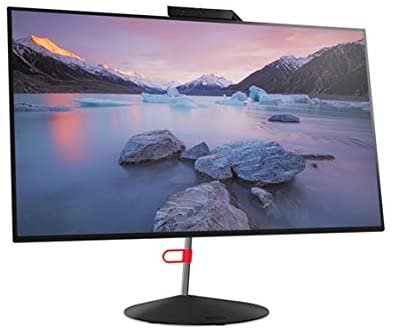
Lenovo is a well-known brand in the IT field, and this time they're presenting their PC monitor with an integrated webcam, the ThinkVision X1 2nd Gen. With its 27-inch screen and slim design of only 4.7 mm thick, this monitor is suitable for all uses, from office work to gaming.
With 4K Ultra HD resolution, enjoy an unparalleled and immersive visual experience. This monitor will bring out even the smallest graphic details with perfect clarity. Featuring an IPS panel with a brightness of 350 cd/m², this screen offers excellent contrast in dynamic mode. The response time is ultra-fast, reaching as low as 4 ms.
Priced at €754.55, this monitor features a Full HD webcam with two integrated microphones, which are very useful for video conferencing. For connecting your devices, the Lenovo ThinkVision X1 2nd Gen offers several ports, including HDMI 2.0, DisplayPort 1.2, and Thunderbolt 3. Finally, for a more immersive visual experience, it is equipped with two 3W speakers.

3. ASUS Business BE24EQK: the PC monitor that suits every budget
Features and Reviews
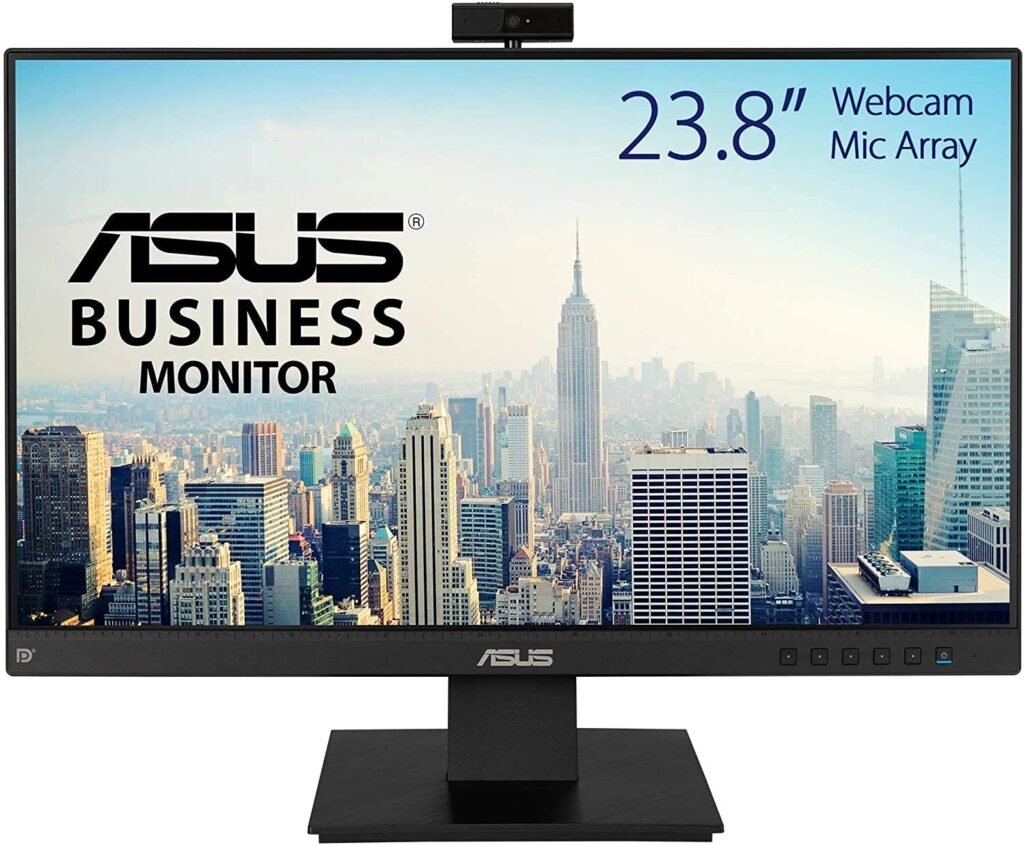
A product from the giant ASUS, this Business BE24EQK model is the most affordable PC monitor with an integrated webcam. For €193.88, this PC screen will provide you with optimal graphics for your various tasks. With its ergonomic design and rounded edges, this monitor is suitable for a dual-monitor setup.
But also, its stand allows you to tilt or rotate it to your ideal viewing position. Its 100 x 100 mm VESA mount lets you attach it to the wall or use it as an articulated arm. With its 24-inch IPS panel, it offers a wide viewing angle with a 16:9 aspect ratio and Full HD resolution.
Boasting a fast 5ms response time, this ASUS monitor offers excellent contrast. The Full HD webcam, microphone, and integrated speakers make communication easy for video conferences. This screen offers more than others, including Flicker-Free and Low Blue Light technologies, which protect your eyes from fatigue and irritation, especially during extended use. For connectivity, this Business BE24EQK model features VGA, HDMI, and DisplayPort ports.

4. ACER B227Qbmiprx: Enjoy a Full HD experience
Features and Reviews
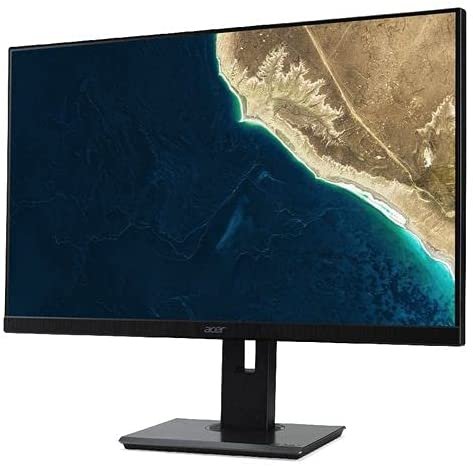
A screen that adapts to your daily needs, this ACER B227Qbmiprx monitor offers a 21.5-inch LED display with a minimalist, borderless design. Featuring an IPS panel and Full HD resolution, it boasts a 16:9 aspect ratio. It also delivers a bright 250 cd/m² brightness and a fast 4ms response time.
This monitor is suitable for various setups, especially if you're looking to use two monitors. With its height-adjustable ergonomic stand, you can also adjust the screen's orientation with pivot and horizontal rotation. Equipped with new ACER Vision Care, Confyview, Flicker-less, and Low Dimming technologies, this monitor will protect your eyes even during extended use.
Featuring an integrated Full HD IR webcam, this monitor allows you to easily conduct video conferences. It also has a built-in microphone for clear and smooth conversations and two integrated 2W speakers. For connectivity, this monitor offers several ports for connecting to your devices: HDMI, DisplayPort, VGA, USB 3.0, and an audio output.

5. HP Elite Display E243m: Adjust the screen position or rotation to suit your needs

Features and Reviews
For €277.40, HP offers its Elite Display E243m PC monitor. With its IPS panel, it boasts a fast 5ms response time and 250 cd/m² brightness. HP also offers a 23.8-inch LED screen with a 16:9 aspect ratio and Full HD resolution.
Compatible with dual-monitor setups, enjoy wide viewing angles for both office work and gaming. The screen is adjustable to 90° portrait mode, tilts, and the height can be adjusted for a comfortable posture. Featuring a built-in webcam with 720p resolution, this monitor is ideal for video calls and Skype conferences.
Even better, to ensure clear and seamless communication with your caller, this HP Elite Display monitor features two digital microphones and integrated speakers. For connecting your devices, this HP monitor offers several ports, including DisplayPort 1.2, VGA, HDMI 1.4, and USB 3.0.

Buyer's guide to choosing your computer monitor with integrated webcam

What are the advantages of having a computer monitor with an integrated webcam?
Webcam economy
This is a clear advantage, but one that shouldn't be overlooked: by buying a computer monitor with a built-in webcam, you save yourself the cost of a separate webcam! Of course, you need to make the right choice from the start. Because if you opt for a computer monitor with a low-quality built-in webcam, you'll have to buy one anyway.
No cables
Who likes having wires and cables everywhere for all their devices? It's not practical and there's always a risk of losing or damaging them, making them unusable… By opting for a computer screen with an integrated webcam, you get rid of the unnecessary: no Bluetooth, no cables, nothing!
Easy to transport
It's important to remember that an external webcam takes up space and needs to be connected each time. So, if you work online and travel frequently, you'll not only have to carry it around but also connect it every time. This isn't a problem with computer monitors that have a built-in webcam.
What are the disadvantages of having a computer monitor with an integrated webcam?
Lower quality than external webcams
External webcams have more space for lenses and other electronic components. As a result, they generally offer higher resolution, better quality photos and videos, and superior sound. If image and sound quality are paramount, then a high-end external webcam will better suit your needs than a standard built-in webcam. Stereo microphones, wide-angle lenses, and advanced autofocus features are all features you can expect to find on more expensive external webcams and are generally not available on built-in models.
Risk of breakage
The major problem with computer monitors that have integrated webcams is that any breakage is much more of a hassle. Think about it: if you break a webcam that's detached from your computer, it's not a big deal. You just have to buy another one. However, when the webcam is integrated into your computer, you'll have to go to a repair shop.
Less security
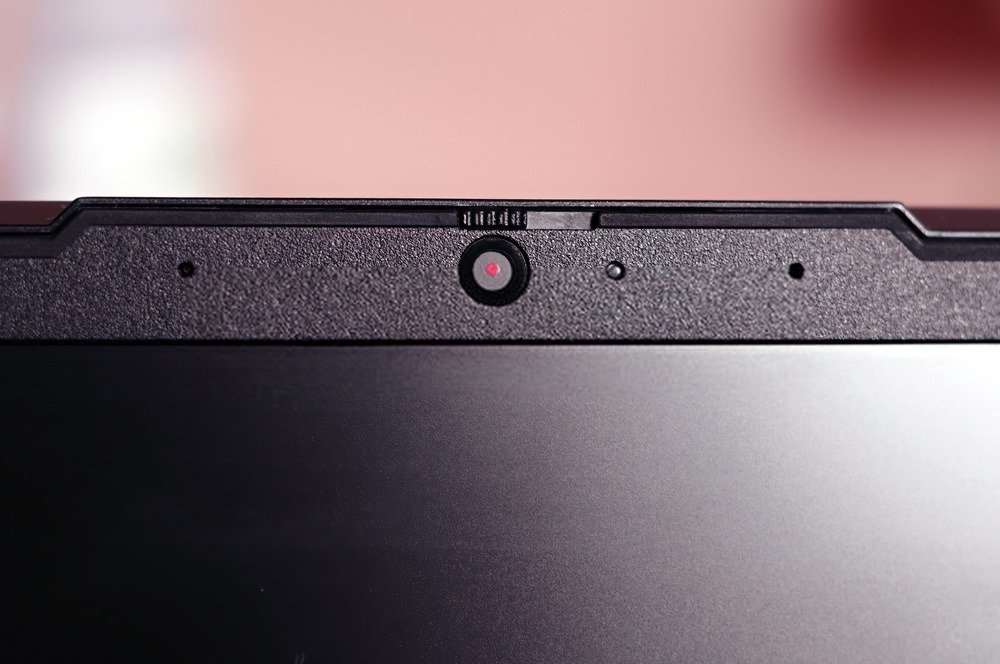
Most people are uncomfortable with a webcam constantly pointed at them, fearing they might be watched by a hacker. Whether this is a real danger or an urban legend, it's true that laptop screens with integrated webcams don't exactly inspire confidence. Whereas a user of a traditional webcam simply has to turn their device in another direction to feel safe. In any case, there's a solution: a small piece of paper over the webcam!
Fixed position
One of the drawbacks of integrated webcams is that they can only be moved along with the screen itself. Whereas an external webcam can be rotated and flipped, an integrated webcam is fixed.
Computer monitors with integrated webcams: the importance of the microphone
Another factor to consider is the presence of a microphone. When you have a computer monitor with a built-in webcam and a microphone, you're all set!
This allows you to have an all-in-one device that ensures easy communication, image and video, with anyone: whether it be your colleagues, your friends, your family or your gaming partners.
However, make sure that the microphone is of acceptable quality and not just standard quality.
Frequently Asked Questions
What is the difference between an integrated webcam and an external webcam?
External webcams, on the other hand, require additional expense and must be installed and configured manually. While most external webcams require very little initial setup and are generally ready to use as soon as they are plugged in, this is still something to consider.
Next, upgrades and maintenance. You don't have a choice of webcams when you buy a computer monitor with a built-in webcam. Choosing an external webcam, however, allows you to select one that meets your needs in terms of price, resolution, and features. Similarly, it is much easier to replace or upgrade an external webcam than a built-in one.
If there is a problem with a built-in webcam, you will have to open the monitor to access the lens and cabling, whereas an external model is much more easily accessible. Troubleshooting with an external webcam is much simpler: you can plug it into another computer to check if it's still working, for example, which isn't possible with an integrated webcam.
Portability also plays a role. External webcams are more difficult to position (on top of a monitor, for example) but also more flexible: you can rotate a webcam's head more easily than you can rotate your entire laptop.
External models are much better suited to remote monitoring situations. For example, they are much easier to place on a window or door. Also, if you're traveling with a laptop, an internal webcam will be more practical because everything is integrated into the computer itself. There are no extra devices or wires.
Finally, there's the matter of quality. External webcams have more space for lenses and other electronic components. They therefore generally offer better resolution, higher-quality photos and videos, and better sound.
If sound and image quality are paramount, a high-end external webcam will better meet your needs than a standard internal one. Stereo microphones, wide-angle lenses, and advanced autofocus features are all features you can expect to find on more expensive external webcams and are generally not available on integrated models.
What quality should I expect from a computer monitor with an integrated webcam?
Also, consider the frame rate! A high frame rate is very important. Webcams with a low frame rate produce images that stutter and freeze periodically on the screen. Frame rate is measured in frames per second, so look for the fps designation on the webcam's packaging. A minimum of 15 frames per second is necessary for streaming video. It's recommended to choose a webcam with 30 frames per second or higher. A webcam with 60 frames per second is ideal, but it will cost more.
Computer monitors with integrated webcam: for whom?
You must consider the characteristics of both the built-in and external webcams: installation, portability, and quality. A computer monitor with a built-in webcam is perfect for professional or home use. For example, the built-in webcam is more than sufficient for participating in business meetings or keeping in touch with loved ones.
Where the built-in webcam might fall short is when you need impeccable video quality. Take, for example, streaming or broadcasting live online. You need ideal image quality for your viewers, which means you'll find what you're looking for with external webcams.
Can I use an external webcam on my computer monitor with a built-in webcam?
Whatever your reason for wanting to use an external camera, these cameras are easy to install and use, even with a built-in webcam.
Start by connecting your external webcam to your computer. Most webcams connect via USB, but other connections are sometimes used. If you're unsure, consult your webcam's user manual.
Next, insert the installation disc that came with your webcam. A window will appear on the screen to guide you through the driver and software installation process.
Launch the software in which you want to use your webcam. This could be instant messaging software, a website, meeting software, or other software with video conferencing capabilities, such as Zoom.
Open the preferences of the software you're using and find the video preferences section. This procedure varies slightly from program to program. If you're having trouble finding it, consult your software's help documentation.
Select your camera as the preferred device for your software. Again, this varies slightly from program to program, but you should find a drop-down list or selection box in the video preferences allowing you to choose from the installed video devices.
Still not working after all these steps? Then try disabling the built-in webcam by going into the settings. Since the built-in webcam will no longer be detected, the external webcam will be automatically displayed.
Computer monitor with integrated webcam, yes or no?
A built-in webcam (ideally with a built-in microphone) gives you an all-in-one device, without the hassle of carrying around a ton of wires and cables and without taking up too much space. Whether for professional, personal, or recreational use, a computer monitor with a built-in webcam is more than enough for most people!
It will be insufficient for a select few who use their webcam for very advanced purposes, such as streaming and live broadcasting. These users should consider an external webcam. But even if you don't fall into this category, you can still use an external webcam alongside your internal one.