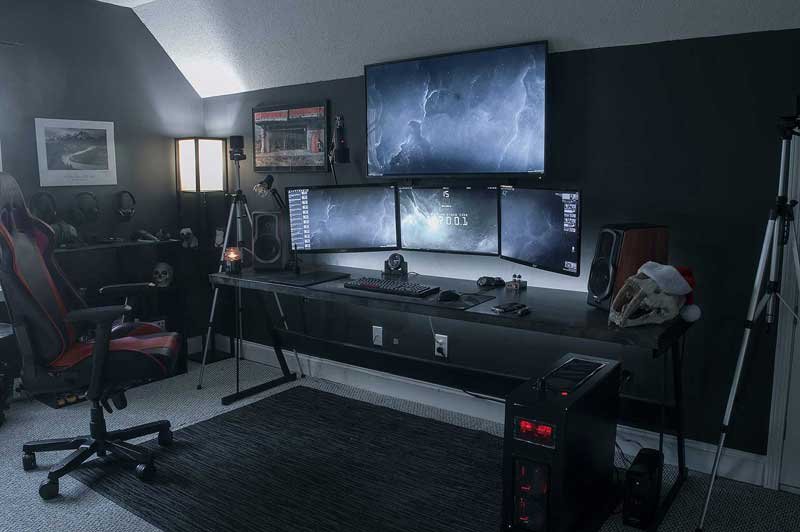
Are you tired of having your monitors right on your desk? It's probably because you've noticed you could free up some space. Or perhaps you're starting to develop some aches and pains due to your working posture.
Indeed, it might be time to look into dual-screen support. Many models have appeared on the market, and they don't all have the same movement and rotation systems.
The best dual-screen setups of the year

Things to know before buying a dual monitor stand
Before rushing into buying a dual-monitor setup, it's wise to understand how the different models work and what they're best suited for. Everything will depend on your work organization and productivity needs, and these points should be carefully considered before making any decisions.
- Arm articulation: you'll find that several systems exist. The higher the price range, the more sophisticated the systems become. But above all, your ergonomic preferences will be the deciding factor when purchasing a dual-monitor stand.
- Your office setup : it's important to keep in mind that not all dual-monitor setups are compatible with all desks. You'll find that some are simply impossible to install if you don't have the right desk, which is why you need to carefully analyze the product you're considering and ensure it's compatible with your setup.
- Neatness of your setup: Depending on the dual-monitor stand you choose, you'll have the option to make your setup as clean and secure as possible. This includes cable management, whether it's thepower supply for your monitors or the connection cables themselves. You'll find that this flexibility isn't always available depending on the dual-monitor stand you select.
COMPARISON OF THE BEST DUAL SCREEN STANDARDS FOR YOUR DESK
1. ErGear Dual Monitor Mount for 13-32 inch screens

Features and Reviews
We begin this review with ErGear's first dual monitor stand and riser. Compatible with 13" to 32" monitors, it's generally quite sturdy. Its movements are smooth, thanks to its dual arms which allow for approximately 45° of tilt, 360° rotation, and 360° swivel. Simply loosen the joints to position it as needed.
This fluidity allows you to use the optimal monitor positioning by placing it at eye level, thus protecting your back and reducing eye strain. You can also use this tilt to correct annoying glare on your screen. ErGear's dual stand allows you to securely mount two monitors, optimizing your performance for multitasking.

2. Dual Screen Tilt
Features and Reviews
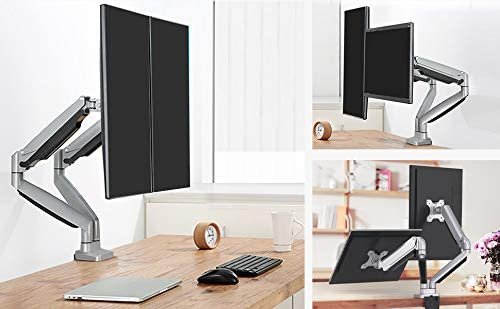
We now move on to the second dual monitor stand and riser from ErGear, the silver EGDS8-E model. If your desk is very small but you have two monitors, this dual monitor stand is the perfect solution! You can customize the way your screens are suspended to your liking; its two arms are ideal for any monitor positioning and will allow you to maximize your performance for gaming or work.
Just like its smaller sibling from ErGear, which we reviewed earlier, its movements are smooth, allowing for approximately 45° tilt, 360° rotation, and 360° swivel. This dual stand offers two installation methods: the first uses a sturdy C-clamp, which allows you to attach it by gripping the back of your desk. The second option involves installing a grommet base, which requires drilling a hole in your desk. It's worth noting that the entire stand is well-balanced thanks to an innovative gas spring counterweight system.

3. Huanuo Dual Monitor Stand for 13-27 inch screens
Features and Reviews
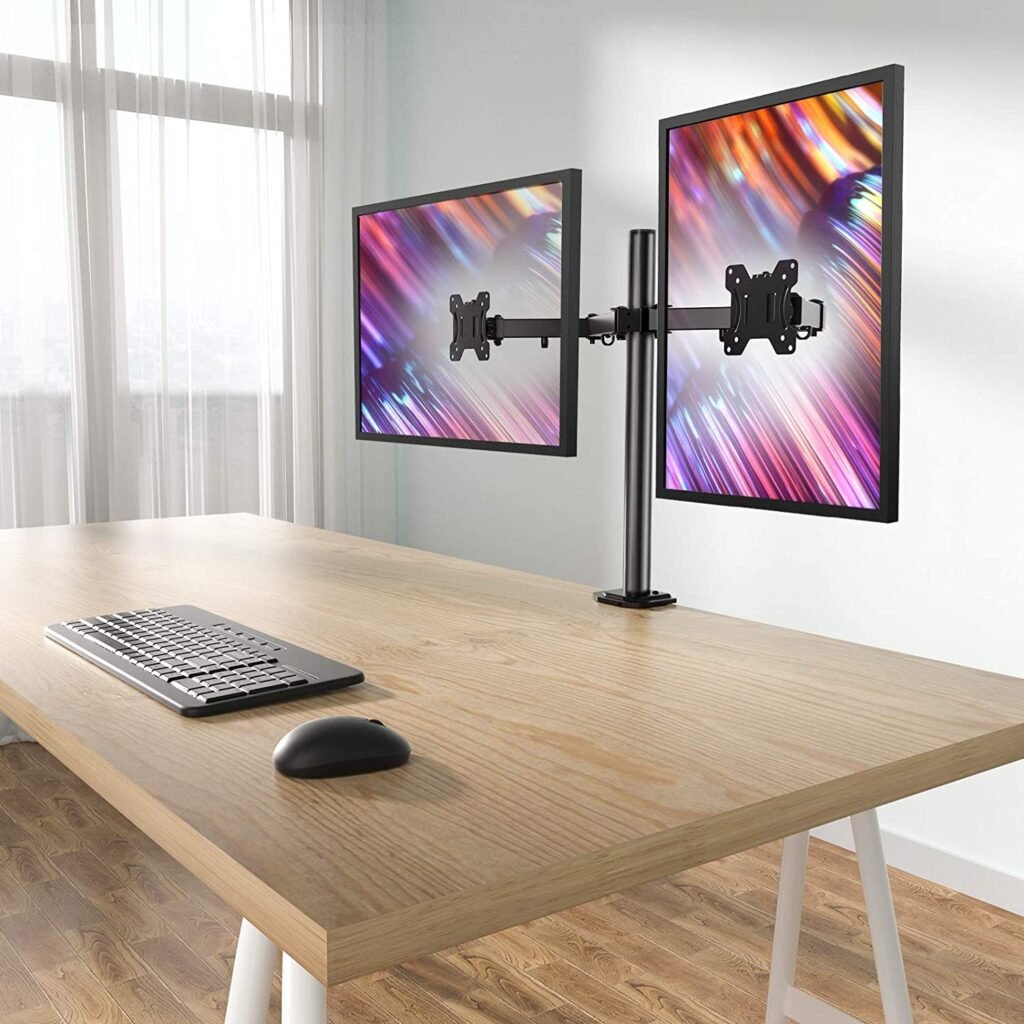
Next up is the HUANUO HNCM7 dual monitor stand. This stand offers quick setup and easy screen positioning adjustment. In fact, with all the included accessories and the installation manual, it can be completed in just 10 minutes, and customer support is quite good. The monitors can rotate 360°, but unlike the two previous monitor stands, they only swivel 180° and tilt 90°.
This dual monitor arm, compatible with VESA standards, can accommodate two screens ranging from 13 to 27 inches. Mounting options are the same as for the previous model: with or without a through-hole (approximately 10 mm diameter). Important: Do not install this dual monitor arm on desks made of particleboard, MDF, or glass. Be sure to check the material of your desk before ordering.

4. Dual Monitor Mounts for 17″-32″ Screens

Features and Reviews
For the last dual monitor stand in our comparison, we once again find the HUANUO brand offering a very good product. It can accommodate two screens ranging from 17 to 32 inches, each weighing less than 9 kg. The stand's smooth movements are thanks to gas spring adjustments. Like its HUANUO counterpart, the HNCM7, this stand offers two mounting options: one with a clamp, where the thickness of your table must not exceed 7.5 cm, and the other requiring drilling a hole in your desk.
For this eyelet mounting system, your table should be no more than 10 cm thick (hole diameter: 1 cm – 5 cm). Mounting the bracket is quick and easy, and all necessary tools are included in the provided toolkit. It is best not to install the dual monitor bracket on glass or particleboard tables. The cable management system allows you to store video and power supply cables directly against the arms, optimizing your workspace and saving space. This monitor riser will perfectly meet your needs; although it is quite expensive, it is of very high quality.

5. Duronic Dual Rotating/Swivel/Tilting Support
Features and Reviews
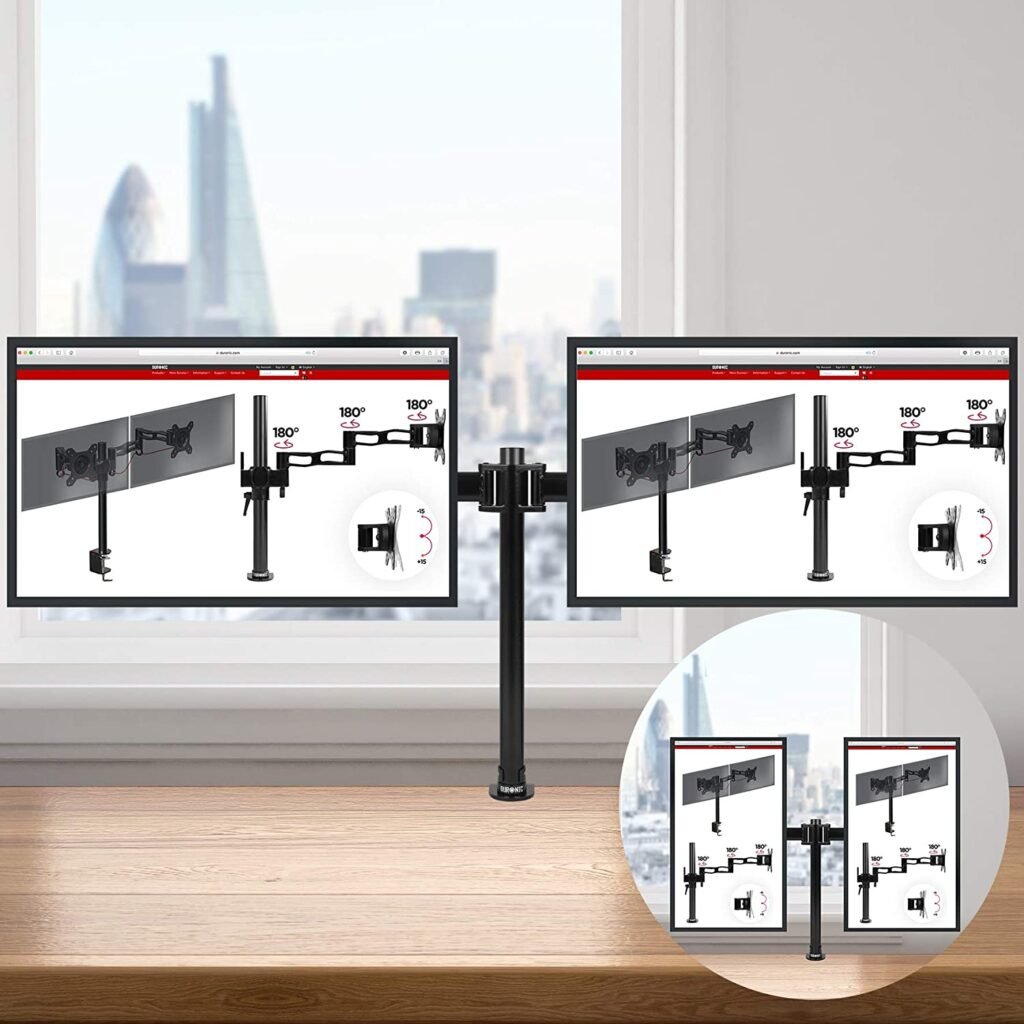
The Duronic DM252 is a cold-rolled steel monitor stand that can support two computer screens. Its flexibility allows you to raise your screens, freeing up valuable desk space. The monitor riser attaches with a C-clamp to any solid desk from 0.5 to 6.8 cm thick.
The arm is 40 cm long; this is the range you'll have to adjust the screen height to suit your needs. Any computer monitor compatible with the VESA interface standard can be mounted on this product. It's important to note that this product is of lower quality than the previously mentioned models, hence its lower price.

Buyer's guide!
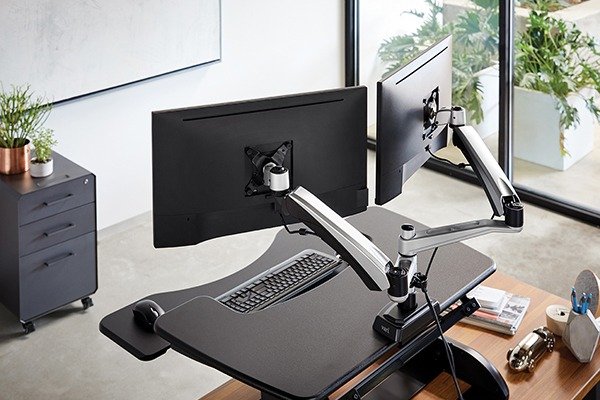
A dual screen stand, but for what purpose?
Who hasn't heard a colleague ask for a second screen at work? Who hasn't wanted to equip themselves with one at home to work more easily? The trader(s) may have started a trend with their ten screens around them, but everyone can aspire to it for laudable reasons.
Using a dual-monitor setup improves readability when working on multiple applications simultaneously. Today, we see many people in creative fields, from graphic designers to video editors, using two monitors. In fact, everyone working in these fields says that working on two screens is a significant advantage during their projects!
Good to know : another solution if you see little point in having two screens on your desk is extra-wide monitors. We invite you to check out our buying guide on ultrawide PC monitors to learn more!
What types of fasteners
You have several mounting options, but your choice will likely depend on your setup. Depending on your desk's design, you might choose one mounting method over another. First, we'll look at the universal mounting method, which allows you to install your dual monitor stand regardless of your desk configuration.
The base in tray form:
The two arms of the support will be directly attached to a flat base. This base is usually very wide in order to support the weight of the two arms as well as the screens attached to them.
The downside is the space it occupies on your office space, as you will lose the space occupied by the base and your screens.
The advantage is that this installation requires no preparation; you place it on your desk and that's it.
The “C” clamp fixing«
This clamp is one of those that will start saving you space. This clamp-style bracket allows you to tuck the edge of your desk inside the clamp. Once in place, simply screw the underside of the bracket to tighten it securely, ensuring it's firmly attached and without any play. Sometimes you'll find this type of bracket in a double-clamp design, which provides an even more stable hold.
The drawback is that if your desk is very thick, it might be difficult to insert the clip into the clamp. Therefore, carefully check that the clip's dimensions are compatible with your desk.
The advantage is that, compared to its predecessor, with this type of installation you will save a really significant amount of space since you will not have a base on which the arms will be fixed.
The eyelet fastening
This is perhaps the sturdiest and most effective mounting method, but it does come with a slight limitation, as this eyelet-type design requires a desk that allows for this particular installation. This type of mounting and desk is generally found in offices; these desks have a fairly large hole into which you can insert part of the support tube to secure it in a clamp-like fashion. This ensures exceptional stability regardless of the weight of your monitors.
The downside : if you don't have this type of desk, you won't be able to use this type of mounting.
The advantage : having this type of mount guarantees unwavering stability regardless of the model and weight of your screens.
In conclusion, the "C" clamp bracket is the most universal bracket, offering an excellent stability-to-space-saving ratio and presenting few drawbacks. The others are equally interesting, but require proper installation, which may not be desirable for everyone.
Two screens with stand vs without stand, which is the best strategy?

Technically, you can place your monitors directly side-by-side without needing a stand. The question is, what's the best setup for which use case? And we'll delve even deeper into the topic of space and flexibility. Clearly, if you don't need to rotate your monitors, you'll probably be tempted to forgo a stand.
When you place your monitors side-by-side without a stand, part of your desk becomes unusable, reducing your total usable surface area. When you have a printer, keyboard, mouse, tablet, and the use of documents, you quickly realize that space becomes a critical factor when the monitors are placed directly on the desk.
What screen size for which device?
Not all screen sizes will be compatible with your mounts, but you can find some that cover most. Currently, the selection ranges from 10-inch screens to 32-inch screens.
It is very difficult to find dual monitor stands that fit 40” screens. You will have the option of positioning 4:3 and 16:9 screens.
Curved PC monitors have appeared in recent years , and from what we've observed, they can be mounted on some monitor arms more easily than others. You'll need to check what type of articulating arm your monitor has
Arm flexibility
Entry-level models may not offer 360-degree screen rotation and may have some limitations in their use. They are generally equipped with a mechanical spring mechanism
Two systems stand out quite clearly: those equipped with gas springs and those equipped with pneumatic springs. These two types of joints allow for similar movements. You will be able to perform 360-degree rotations, as well as greater tilt.
These arms are even used beyond their standard single-person function, as you can position them to move from one end of the desk to the other for presentations or teamwork. They offer excellent user comfort and, best of all, are available at very affordable prices. Needless to say, we highly recommend this type of setup.
FAQ
Height adjustable or not?
These latter arms are not equipped with a main column; you'll notice they are completely independent and move within a wider, more separate range of motion. Thanks to their flexibility, you can raise or lower them independently. This flexibility allows you to raise one arm while lowering another, which isn't possible with those mounted via a main column.
Overall, the range of heights is virtually identical between the two systems. The only difference is that you'll encounter some limitations in independent movement when they are connected to a main column.
Can all the screens be fixed?
You must ensure that your monitor has four holes arranged in a square on the back. These are the holes where you'll attach the mounting screws over the mount's cover, securing it to your monitor so they become a single unit. This type of mounting uses a standard called VESA, which has become widely used.
However, be aware that VESA dimensions vary between monitors. You must verify that the spacing between the mounting points is compatible with the mount you intend to purchase; otherwise, you simply won't be able to attach your monitors. In short, double-check that your monitor is VESA compatible and that the screw spacing matches your mount.
How can I organize my cables?
Beyond aesthetics, there's also a safety issue: if you leave your cables exposed, you risk accidentally pulling on one and causing problems. So, it's not just about safety; it's also about a more visually appealing, cable-free desk – it has to be said, it's very clean.
Regarding dual monitor mounts, not all of them allow you to thread the cables through the mounting arms.
This is especially true for entry-level mounts that are mounted on a central column. These arms, which have limited movement, generally lack a channel through which cables can be threaded.
This won't be the case, however, for those equipped with springs, as the internal mechanism of the arms will be covered by a protective sleeve into which you can insert all your monitor cables. Generally, these cables run through the arms and exit from the bottom or back of your desk.
However, be sure to check the length of your cables, as this will require more cable management than if they were unsupported; this is something to keep in mind.
What is the relationship between support systems and health?
In recent years, as computer use has become the norm, new ailments have emerged: neck pain, head pain, back pain, and more.
The ideal position for working effectively is to maintain an upright posture, with your gaze directly in line with your body. Looking upwards or downwards will inevitably lead to pain or tension. This understanding has driven companies to invest in monitor stands.