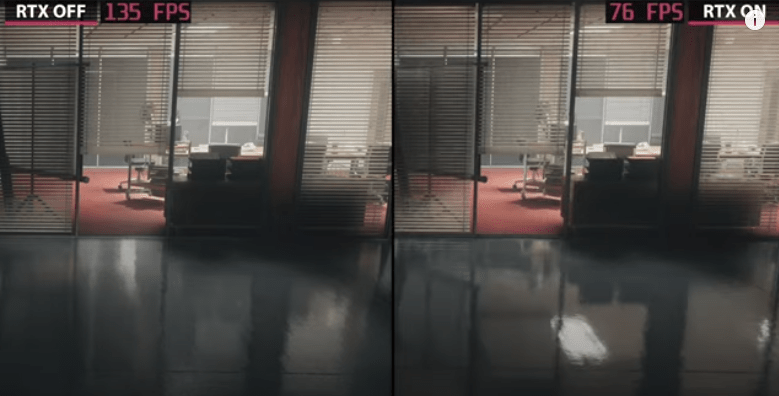
AMD has just confirmed that its latest generation cards support ray tracing if the game uses APIs from common platforms such as Microsoft DXR and Vulkan, and not proprietary extensions. Therefore, ray tracing can be enabled with AMD cards, for example, for the title Control, but not for Quake II RTX or Wolfenstein Youngblood, whose extensions were created by Nvidia.
AMD did not provide benchmark data on ray tracing and super sampling (or Super Resolution) when it announced the release of its Radeon RX 6000 series cards on October 28th. It released benchmark results with ray tracing disabled. This left experts uncertain and suggested that AMD's new generation cards were unable to outperform Nvidia's GeForce 3000 series cards with ray tracing enabled.
Some information provided by AMD
AMD has not yet presented details to the press regarding ray tracing and supersampling . AMD will likely do so in the coming days, as the first Radeon RX 6000 series cards will be released on November 18th. However, in the meantime, AMD stated on AdoredTV that these cards will support ray tracing for all games with industry-standard APIs such as Microsoft DXR and the Vulkan API. These cards will not, however, be compatible with Nvidia's proprietary extensions.

It's clear that Nvidia used its own extensions because it was a pioneer in this field. It was the first to launch ray tracing, even before the gaming industry followed suit. The word has now been passed to the gaming industry to use standardized, common extensions. Other graphics card manufacturers like Intel could also produce cards that support ray tracing, among other features, and it's clear that this industry standard will be used by all of them. As for supersampling, Nvidia's equivalent of DLSS, it seems that AMD is working on it. It probably won't be available at the launch of the Radeon RX 6000 series cards, but Microsoft's DirectML will be used instead. This open API is cross-platform and can be used by all graphics card manufacturers, unlike DLSS, which can only be used by Nvidia cards.
Benchmarking comparing next-generation AMD and Nvidia graphics cards

The Radeon RX 6000 series features compute units, each equipped with an accelerator. These accelerators, called RAs (Ray Accelerators), are used when ray tracing is enabled. Since the Radeon RX 6900 XT has 80 compute units, it therefore has 80 ray accelerators. The Radeon RX 6800 XT has 72 RAs, and the RX 6800 has 60. The manufacturer announced a 13.8x acceleration with a frame rate of 471 FPS for the Radeon RX 6800 XT .
Enthusiasts have been testing Nvidia's RTX 3000 series cards using the DXR API. The results are conclusive: Nvidia's GeForce cards remain the undisputed leaders in ray tracing. The GeForce RTX 3080 achieves a frame rate of 630 FPS , while the GeForce RTX 3090 reaches 749 FPS . These test results mean that the GeForce RTX 3080 is 33% more efficient than the Radeon RX 6800 XT, and the GeForce RTX 3090 is 60% faster than its AMD rival.
We eagerly await the details that AMD will provide for these next-generation cards, but these tests confirm Nvidia's superiority in ray tracing.