Nvidia plans to acquire ARM. In this case, in addition to GPUs and CPUs, a new chip called a DPU will be introduced. The company explains what it is and outlines its roadmap for the coming years. The CPU and GPU have been components of our computers for decades, and while the role of the GPU has evolved beyond graphics to perform general-purpose operations that take full advantage of its parallel computing capabilities, new types are emerging in the computing industry: DPUs.

DPU, what is it?
With the acquisition of ARM, the new Data Processing Units (DPUs), resulting from the acquisition of Mellanox, will also come into play. According to Nvidia CEO Jen-Hsun Huang, DPUs will represent one of the three main pillars of computing in the future. The CPU is for general computing, the GPU for accelerated computing, and the DPU transfers data to the data center and processes the information.
Nvidia defines the DPU as a -chip (SoC) comprised of a high-performance , software-programmable, multi-core processor equipped with a high-speed network interface and specialized engines designed to accelerate specific operations such as artificial intelligence. All these capabilities are essential for delivering isolated, bare-metal, and cloud-native computing, which will define the next generation of cloud computing. Essentially, it is a specialized processor that can handle network workloads and storage security.
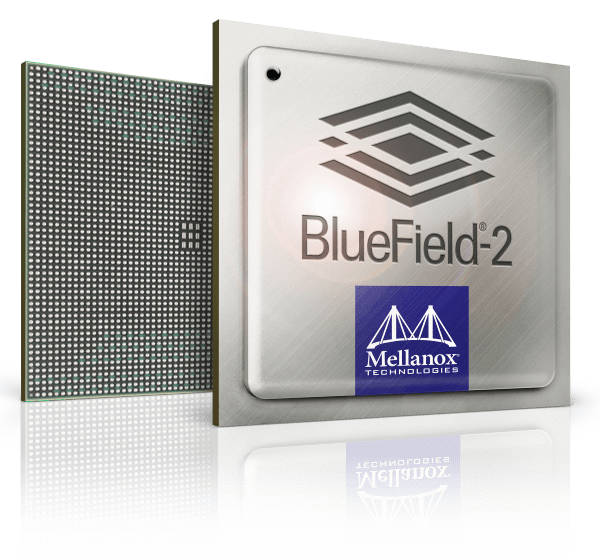
The DPU can be used as a standalone integrated processor , but it is often integrated into a SmartNIC, which is a network interface controller essential for next-generation servers. In Nvidia's case, the company has developed a DPU called BlueField-2. It is currently in the testing phase and will be ready for delivery to partners in 2021.
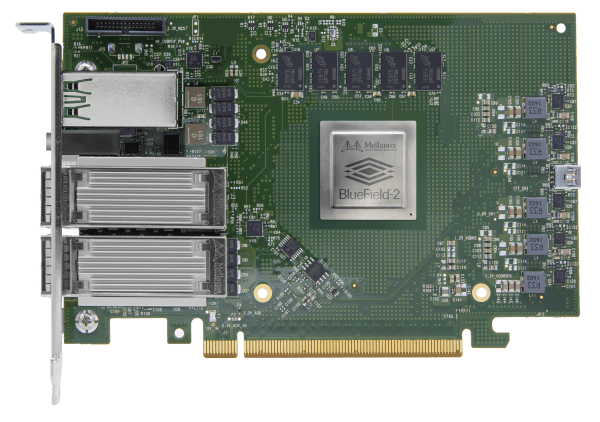
The famous BlueField-2
Bluefield-2 is based on a custom SoC. It features eight ARM Cortex-A72 cores and two VLIW acceleration engines. It includes a ConnectX-6 DX network card for high-speed network connectivity. Nvidia will release two cards equipped with DPUs: Bluefield-2 and Bluefield-2X. Bluefield-2 is a traditional smartNIC with a DPU and two network ports. Bluefield-2X, in addition to the DPU, includes a GPU based on the Ampere architecture (likely the GA102, but this is not confirmed). This is to accelerate what Nvidia calls "networked computing." Looking ahead, Nvidia already has a clear roadmap, with the BlueField-3 and BlueField-4 families already in development: BlueField-3 will be an improved version of BlueField-2, while with BlueField-4, the company plans to build a graphics card with a single high-performance DPU, capable of handling the workload of a combined DPU and GPU. It aims for AI computing performance of up to 400 TOPS.
As already done in the field of GPUs with CUDA, even in the case of DPUs, the American company is working on the software side by proposing what is called the "Data Center Infrastructure-on-a-Chip" (DOCA) architecture, that is to say a programming model for DPUs that can make life easier for developers.