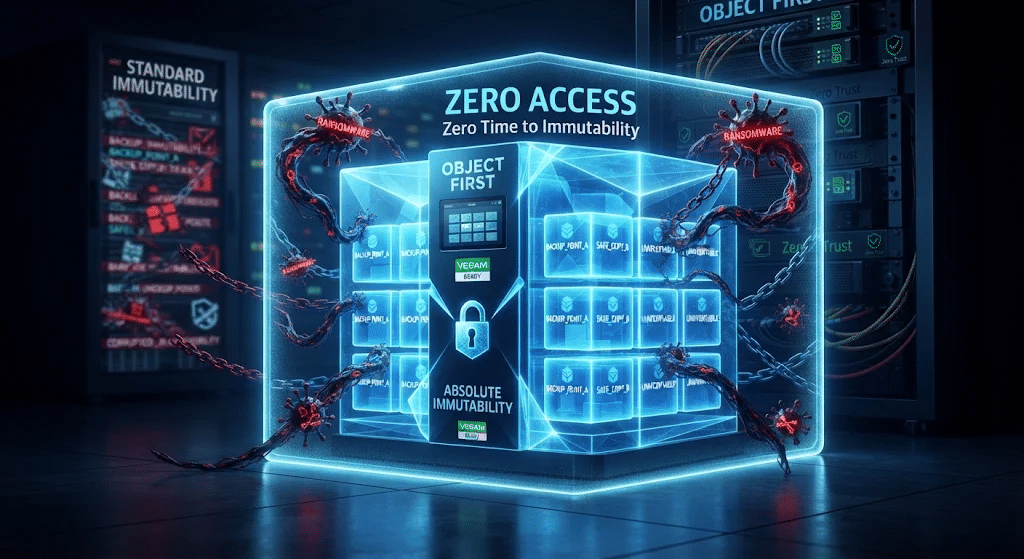
Ransomware targets backups in four out of five attacks, aiming to force a ransom payment by destroying your ability to restore data [1]. Standard immutability is not enough to completely eliminate this risk. When attackers obtain valid administrator credentials, policy-based immutability can be bypassed or disabled, and restore points then become just as vulnerable to ransomware as the production data they were meant to protect.
83% of organizations have experienced at least one ransomware attack in the past two years [1]. No system is impenetrable, no matter how robust its defenses. That's why it's essential to assume that a breach will occur and to prepare for recovery. Organizations that rely on standard immutability risk discovering this vulnerability too late.
Key points
- Ransomware targets backups in 4 out of 5 attacks. Policy-based immutability can be bypassed by anyone with administrator credentials, which is precisely the scenario exploited by ransomware [1].
- Absolute immutability applies the Zero Access principle to destructive actions: no one, not even the most privileged administrator or an attacker, can modify or delete backup data.
- 76% of organizations claim to have immutable safeguards, but among them, 83% acknowledge that their immutability is limited [1].
What is immutability?
In its simplest definition, immutability means that data cannot be modified or deleted once recorded, offering a secure approach to protecting critical data. However, this definition doesn't account for the complexity of its implementation, nor the hidden exceptions and vulnerabilities it may contain. Therefore, organizations must ensure they have absolute immutability.
What is absolute immutability?
Absolute immutability means zero access to destructive actions. No one, not even the most privileged administrator or an attacker who has completely compromised the system, can modify or delete backup data. It is fundamentally based on an "assume breach" logic: even if your credentials are stolen, your infrastructure is compromised, or a colleague becomes malicious, your backup data remains untouchable.

Why emphasize this point? Because not all solutions claiming to be immutable actually are. Object First introduced the concept of absolute immutability to clearly distinguish itself from weaker, policy-based protections, which can still be circumvented under certain conditions [2].
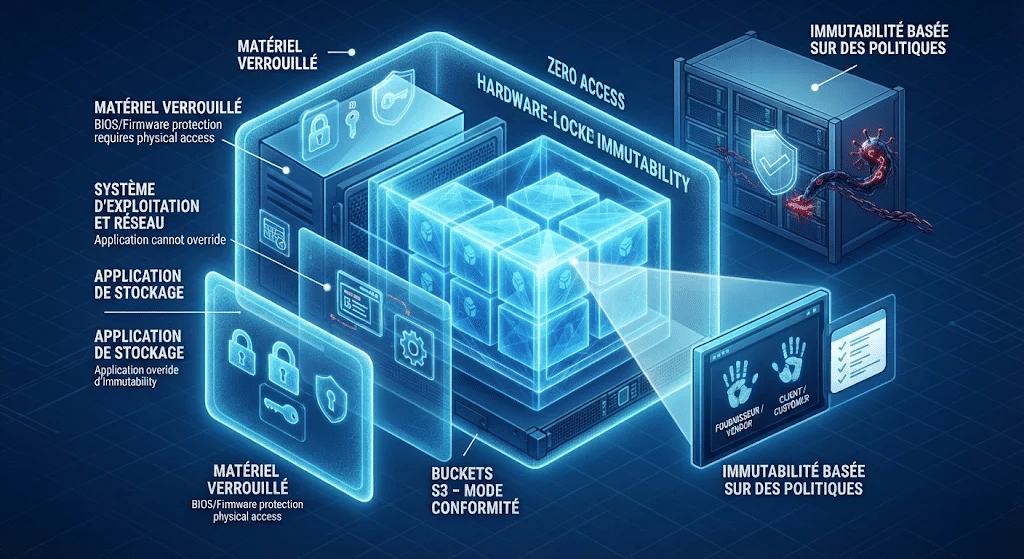
This Zero Access principle for destructive actions must be independently verified by third-party security testing. It applies to every layer of the immutable storage, including the hardware, which is locked by the appliance vendor and cannot be modified by the administrator.
- S3 Buckets: in compliance mode, data cannot be modified or deleted, without exception.
- Storage application: administrator-level access is restricted; configuration cannot override data immutability.
- Operating system: root access is completely blocked.
- Hardware/BIOS: Any firmware modification requires physical access. The equipment is locked by the vendor and cannot be modified remotely.
- Only pre-approved maintenance procedures relating to the storage application and the operating system are permitted, with an eight-eyes review for exceptional cases: two people on the supplier side and two on the customer side must all approve them.
How absolute immutability protects against ransomware
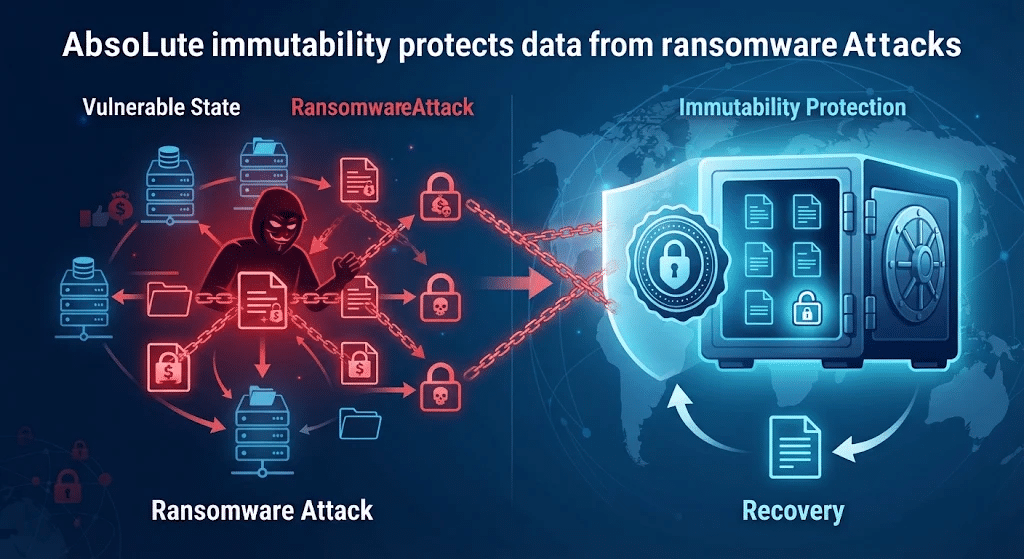
The principle of least privilege, one of the foundations of Zero Trust, limits administrator permissions. Zero Access goes further by removing any administrator's ability to perform destructive actions, thus protecting backup data from attackers with administrator privileges or from malicious collaborators.
- It assumes that the attacker already possesses valid credentials. The system is designed with the understanding that credentials may eventually be compromised: therefore, no user, legitimate or malicious, can perform destructive actions alone. Policy-based immutability rests on the opposite assumption.
- It leaves no gap between writing and locking. With Zero Time to Immutability, backup data is immutable as soon as it is written: no grace period, no intermediate transit zone, and no background tasks to run before the lock is activated. Deduplication appliances and in-house backup configurations apply immutability after the fact; during this interval, the data remains fully modifiable and susceptible to alteration.
- It eliminates the workarounds that ransomware targets. Compliance mode ensures that retention cannot be removed, shortened, or bypassed by any user, including privileged administrators. Governance mode allows privileged users to modify or delete retention settings, creating a single point of failure for ransomware, as an attacker with administrator access can delete or alter protected data.
- It preserves healthy restore points. Versioning maintains multiple immutable iterations of data, and previous versions can be safely examined after a cyberattack to determine when and where the infection occurred. It is then possible to identify healthy versions, isolate compromised versions, and restore any point in time.
- It can be proven, not just asserted. Absolute immutability requires more than a vendor's claims: it must be independently verified, which is only possible if assessments are based on open, industry-standard protocols. 89% of IT leaders believe that vendor immutability claims should be validated by third-party audits or testing, but only 56% actually use third-party testing and reporting [1].
If "immutable" data can be overwritten by a backup or storage administrator, vendor, or attacker, your storage solution cannot be considered absolutely immutable [2].
Object First: a backup storage system with absolute immutability
When ransomware strikes—because the question isn't if, but when—your future will depend on your cyber resilience. Object First is your ultimate defense: backup storage with absolute immutability, designed specifically for Veeam.
Built on Zero Trust, tested and verified by third parties, Object First requires no security expertise and scales with your business. When backup storage for Veeam is this secure, simple, and powerful, you and your organization are Simply Resilient.
David Bennett, CEO of Object First, states: “Organizations cannot afford delays when ransomware strikes: their revenue, reputation, and jobs are at stake. Resilience isn’t just about protecting data; it’s about how quickly you can restore when it matters most. Object First offers Veeam users an easy-to-use, ransomware-proof solution for faster recovery and simple resilience.”