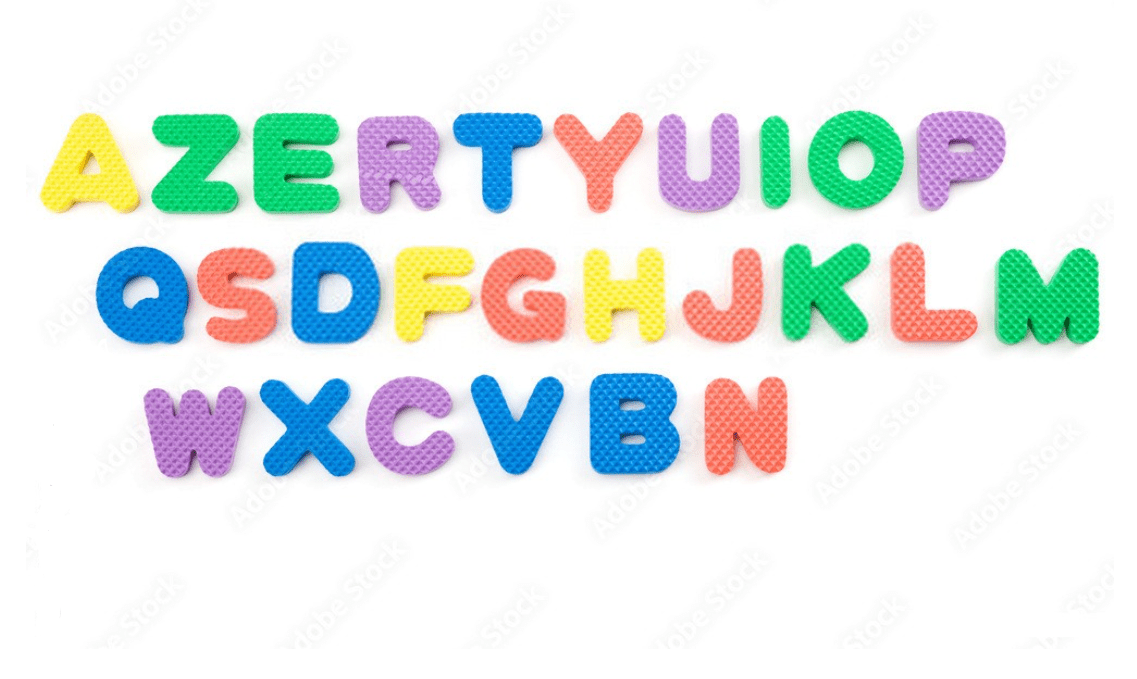
You've probably typed these letters on your keyboard before, out of boredom or curiosity. But do you know why the keyboard keys are arranged in this order? What is the origin of the AZERTY layout, used mainly in France and Belgium? And are there any more ergonomic alternatives better suited to the French language?
In this article, we will explain everything you need to know about the history and evolution of the AZERTY keyboard.
The origin of the AZERTY keyboard

The AZERTY keyboard is an adaptation of the QWERTY keyboard, invented in the United States in the 19th century for typewriters. QWERTY was designed to prevent the stems of adjacent keys from jamming during rapid typing. To achieve this, the most frequently used letters in English were spaced further apart on the keyboard.
The AZERTY keyboard appeared in France at the end of the 19th century as a variant of QWERTY adapted to the specificities of the French language. The letters A and Q are reversed, as are the letters Z and W. The letter M is placed at the end of the last row of letters, and not next to the N as in QWERTY. Additional keys are added for accents and special characters, such as ç, è, and à.
The limitations of the AZERTY keyboard
The AZERTY keyboard is currently the most widespread in France and Belgium, but it has many drawbacks. First, it is not very ergonomic, as it often forces the use of the same hand or finger to type frequently used letters.
For example, the letter E, which is the most frequently used letter in French, is on the same row as R, T, Y, U, and I, which puts a lot of strain on the right index finger. Similarly, A, S, D, and F are on the same row as Q, W, X, and C, which tires the left index finger.
Furthermore, the AZERTY keyboard is not very practical for writing French correctly, as it makes it difficult to access certain punctuation marks or certain accented capital letters.
For example, to type a question mark, you have to press the Shift key and the 6 key. To type a capital É, you have to make a combination of three keys: Alt Gr + Shift + 2. Some characters, like the œ or the « », are not even present on the standard AZERTY keyboard .
Alternatives to the AZERTY keyboard
Faced with the problems posed by the AZERTY keyboard, initiatives have been launched to offer alternative layouts that are more ergonomic and better suited to French. Among them are:
- The BÉPO layout is inspired by the Dvorak method, which places the most frequently used letters in the center of the keyboard, on the home row. The BÉPO layout reduces finger movement and balances the use of both hands. It also facilitates access to accents and punctuation marks. The BÉPO layout has been recognized as an experimental standard since 20096.
- The enhanced AZERTY layout: This is a layout proposed by AFNOR (the French Standardization Association) in 2016, as part of a voluntary standard project for the French keyboard. The enhanced AZERTY retains the basic AZERTY keyboard layout, but introduces modifications to facilitate French typing, such as the ability to type accented capital letters using the Shift key, and the addition of keys for the œ, « », and en dash symbols. The enhanced AZERTY layout is compatible with existing keyboards; you simply need to change the operating system settings .
What are the differences between the enhanced AZERTY keyboard and the standard AZERTY keyboard?
The enhanced AZERTY keyboard is a proposal from AFNOR to standardize and modernize the French keyboard. It differs from the standard AZERTY keyboard in several aspects:
- It allows you to type accented capital letters with the Shift key, without having to use the Alt Gr key or a complex key combination.
- It adds keys for characters specific to French, such as œ, « », € or the en dash.
- It modifies the layout of certain symbols, such as the question mark, exclamation mark, or semicolon, to make them more accessible.
- He introduced a dead key for ligatures, such as æ or fl.
How do I use the enhanced AZERTY keyboard?
To use the enhanced AZERTY keyboard, follow these steps:
- Download and install the NF Z71-300 standard on your computer, following the instructions available on the AFNOR website.
- Change the keyboard layout in the operating system settings, choosing enhanced AZERTY as the default layout or as an alternative option.
- Get used to the new keys and symbols by consulting the user guide provided by AFNOR.
- Optionally, change the stickers or keys on your physical keyboard to match the enhanced AZERTY layout.
Conclusion
The AZERTY keyboard is the result of a historical adaptation of the QWERTY keyboard, but it is not optimal for writing in French. More ergonomic and practical alternatives exist, such as BÉPO or the enhanced AZERTY, which can be adopted by users concerned about comfort and typing quality.
And you, what keyboard layout do you use? Are you ready to change your habits to try a new keyboard?