Designed for gamers, the AMD Radeon R7 Graphics was released in January 2014. It remains one of the most highly recommended graphics cards to this day. Let's take a closer look at some of its features.
To show even more detail, we will see, at the end of the article, the main characteristics of one of the models: the AMD Radeon R7 260X 2GB.
Discover the best graphics cards selected by pro gamers!

Robust and high-performing
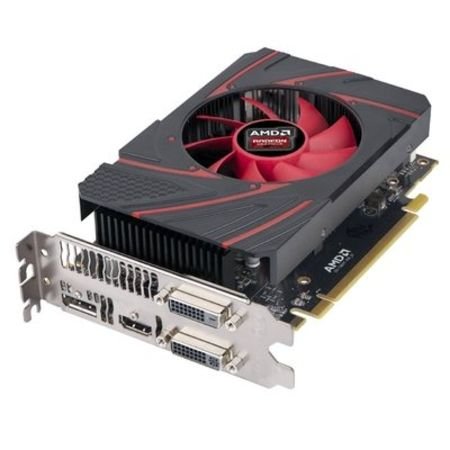
When discussing the AMD Radeon R7 Graphics, its low power consumption is often mentioned. Furthermore, it's an integrated graphics card based on the GCN 2.0 architecture. For your information, GCN stands for "Graphics Core Next".
This graphics card natively supports 4K resolution, or 4096 x 2160 pixels. This is thanks to "Eyefinity" technology, which was designed to support HD and Ultra HD. It can therefore display the animations of most games smoothly.
On the audio side, it supports Dolby TrueHD and DTS-HD Master Audio formats. Suffice it to say, this is high-quality sound. Indeed, Dolby TrueHD is a lossless audio codec. DTS-HD Master Audio is also a lossless format that allows for 8-channel sound reproduction.
In general, the AMD Radeon R7 Graphics combines low power consumption, high performance, and very attractive prices.
The graphics are simply stunning, especially when compared to resource-intensive 3D games.
The latest models of this integrated graphics card have at least 2GB of DDR5 memory.
High compatibility
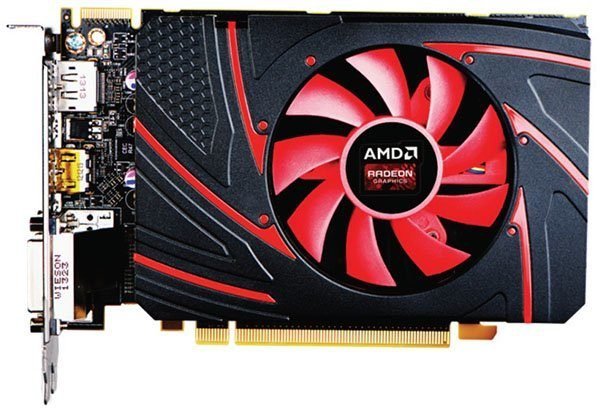
The AMD Radeon R7 Graphics is compatible with DirectX 11.2, which is natively present on computers equipped with Windows 8.1.
The graphics card is quite small and compact. This makes it easy to install in small tower cases.
This graphics card performs exceptionally well in most online games. Of course, if you try it with very demanding 3D games, you'll likely be disappointed. However, for most games, the AMD Radeon R7 Graphics is more than adequate.
Connectivity
Generally, there are 3 video outputs:
- A DisplayPort output
- A DVI output
- An HDMI output
On some models of the R7 series, there are 2 DVI outputs.
Detailed specifications of a model: the AMD Radeon R7 260X 2GB
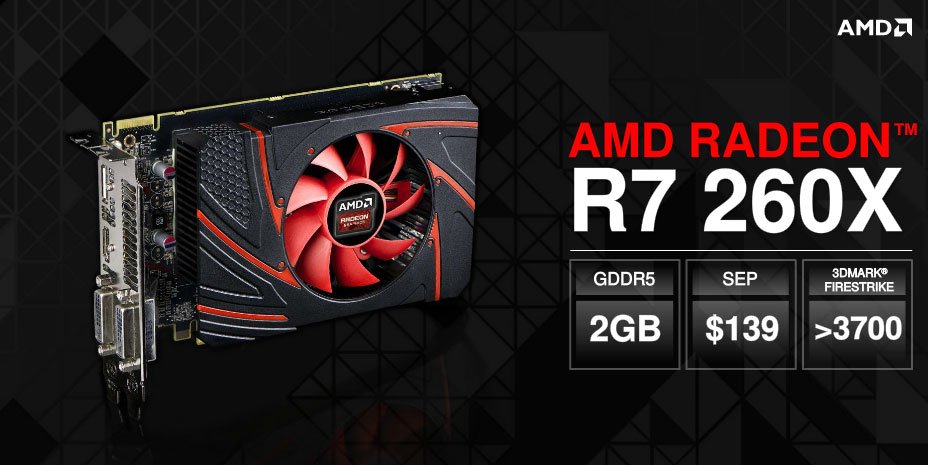
This graphics card incorporates the main features of the series, plus some unique functionalities.
It is just as compact as the others because its length does not exceed 17 cm.
There is a feature that allows the fan to stop when the computer screen goes into sleep mode: this is the ZeroCore Power function. Power consumption is then reduced.
The AMD Radeon R7 260X features a Bonaire graphics processing unit (GPU). This GPU has 896 compute units, 16 rendering units, and 56 texturing units. The GPU clock speed is 1100 MHz. The memory clock speed is 1625 MHz. Its bus is 128 bits. This card supports H.264 and HEVC (or H.265) codecs. It also supports DirectX 12, OpenGL 4.6, OpenCL 2.0, Vulkan 1.2, and more
The AMD Radeon R7 260X is fairly quiet when not under heavy load. However, it becomes quite noisy during gaming. That said, this shouldn't bother most gamers while they're playing.
It is often compared to the Nvidia GeForce GTX 650 Ti graphics card, which remains quite quiet, even when under heavy load.
The Radeon R7 260X is compared to its sister, the Radeon HD 7790. However, the latter only has 1 GB of memory and displays lower frequencies.
Connectivity options include four outputs: 2x DVI, 1x HDMI, and 1x DisplayPort. The graphics card connects to the rest of the system via a PCI-Express 3.0 x16 slot.
Conclusion
The AMD Radeon R7 Graphics remains one of the most popular graphics cards today. Its price-to-performance ratio is very good. It natively supports HD and 4K formats. It offers high-quality sound and has 2GB of GDDR5 memory. Some models can be found for around €125, for example. At that price, it's a no-brainer…