Have you decided to invest in an extra-large screen to see more? You've come to the right place! Discover our selection of the 5 best Ultrawide screens, a buyer's guide to help you choose, and a frequently asked questions section to answer your queries.
Things to know before buying an ultrawide screen!
Extra-large monitors are, as their name suggests, large. So make sure you have enough space on your desk to install it.
- Due to their large size, some ultrawide monitors are curved, giving you the feeling of being completely immersed in what you're doing. Once you've experienced curved PC monitors, you won't be able to live without them.
- As you might expect, your budget will need to be larger than for a standard monitor. However, you'll have a more immersive experience
Comparison of the best Ultrawide screens this year

1. The Samsung C49RG90, an extra-large curved screen that dominates
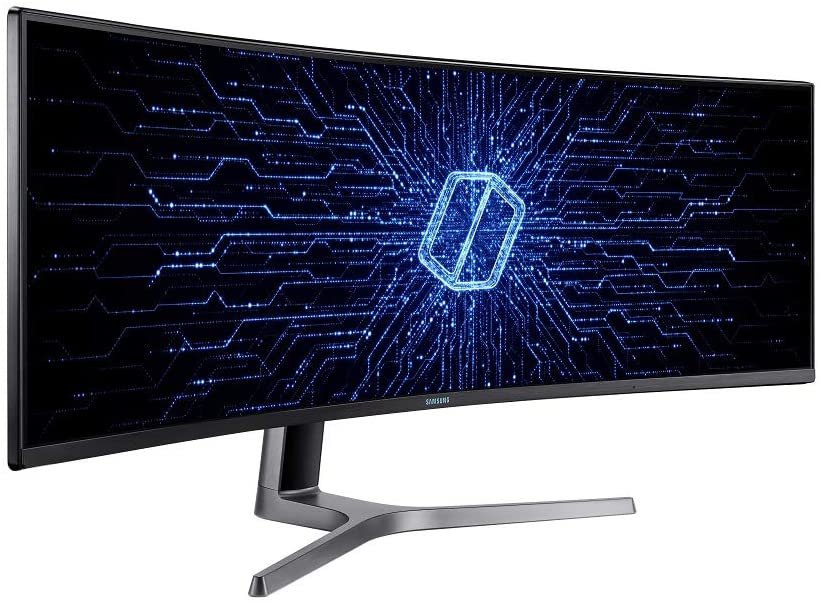
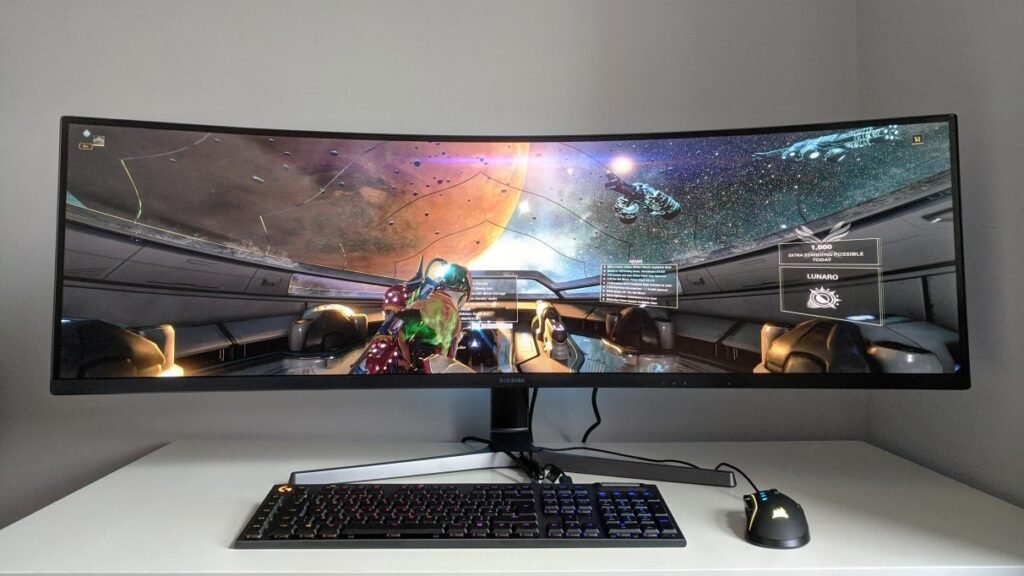
We begin our comparison with Samsung's top-of-the-line offering. This 49-inch ultrawide curved LCD monitor is perfect for achieving an unparalleled viewing experience in most setups. With a 5K (5120 x 1440 pixel) and a 120Hz refresh rate, you can enjoy exceptional viewing of your favorite programs while multitasking or playing your favorite video games. HDR 1000 and AMD FreeSync technologies allow the former to reach a brightness of 1000 nits and the latter to synchronize images to eliminate tearing and stuttering. With its 4-millisecond response time, you won't miss a thing.
Benefits :
- 49" curved screen for optimal viewing
- Ultra HD in 5K
- Good response time of 4 milliseconds
- HDR 1000 for brightness and AMD FreeSync for synchronization
Disadvantages:
- Its high price

2. The Millenium MD49, a borderless monitor for esports
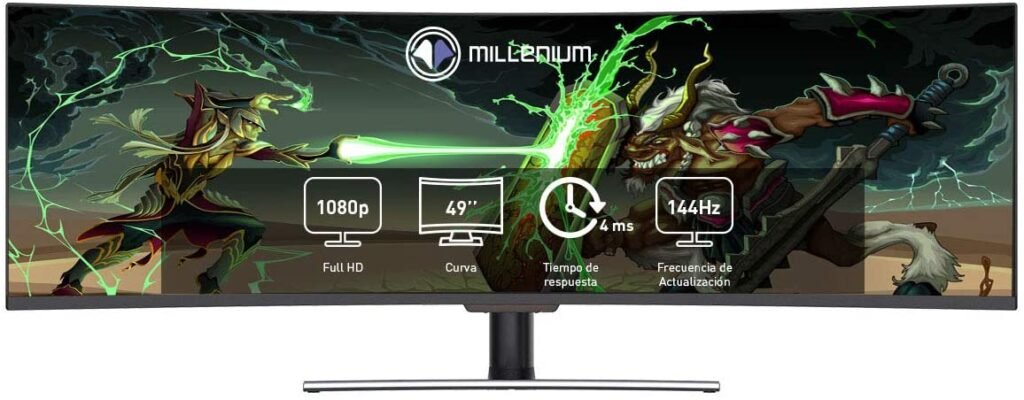
If you're a hardcore gamer looking for an ultrawide monitor for online gaming, the Millenium MD49 is the curved PC monitor for you. Designed and developed by eSports players, the MD49 meets all the criteria for optimal gaming conditions. With its borderless bezel and curved profile, you can focus 100% on your game by minimizing distractions. Its 144Hz refresh rate and 4ms response time deliver maximum performance when combined with AMD FreeSync and Nvidia G-Sync technologies. The MD49 is undoubtedly a top-of-the-line 4K PC monitor for gamers .
Benefits :
- Created for gamers
- Ultra-thin screen bezels
- 144 Hz for perfectly smooth gameplay
- FreeSync and G-Sync compatible
Disadvantages:
- Brightness that is sometimes quite low

3. The LG Ultrawide 35WN73A-B, a QHD screen for professionals

If you're looking for an extra-large PC monitor to work and boost your productivity, this LG Ultrawide is for you. Offering 33% more screen space than a 16:9 monitor, this 39-inch QHD 3440 x 1440 display is perfect for multitasking with multiple windows open simultaneously. No more need to use Alt+Tab! The 100Hz refresh rate provides a smoother visual experience, and the HDR display, covering 99% of the sRGB color gamut, delivers spectacular results. The OnScreen Control software lets you customize your workspace to your needs in just a few clicks. Finally, the USB Type-C port on the back of the monitor allows you to connect your latest-generation peripherals, such as a laptop or smartphone.
Benefits :
- Perfect for professionals
- But it's also suitable for gamers
- Simplified multitasking management thanks to OnScreen Control
- AMD FreeSync and Dynamic Action Sync compatible for image synchronization
- USB Type-C port
Disadvantages:
- It's quite heavy, so you'll need a strong arm if you want to mount it on the wall

4. Millenium MD34PRO, a 34" curved, responsive, and competition-ready board

The Millenium MD34PRO, like its counterpart, is a curved gaming PC. Smaller than the MD49, it's nevertheless faster . Its 1-millisecond response time ensures ultra-fast action. Combined with its 144Hz refresh rate, the MD34PRO delivers performance and a smooth gaming experience . The curved QLED screen and minimal bezels will immerse you in the heart of the action. So, if your budget doesn't allow for the MD49, choose this Millenium model; you'll lose some screen size but gain in responsiveness.
Benefits :
- Perfect for gamers
- Ultra-fast response time of 1 millisecond
- High refresh rate at 144 Hz
- Curved QLED screen with a 178/178 viewing angle
Inconvenience :
- No real drawbacks

5. The Samsung S34J550WQU, an Ultrawide flat screen with energy saving

If you don't want a curved screen, this ultrawide PC monitor from Samsung is an excellent choice! Its 3440 x 1440 HD resolution in 21:9 aspect ratio with a 75Hz refresh rate isn't as high-performing as the other monitors in this comparison, but it remains a solid option for gamers and professionals. Where this Samsung model truly shines is in its energy efficiency and visual comfort . The first advantage comes from automatic brightness adjustment based on ambient light, reducing power consumption by up to 10% (up to 50% with manual adjustment). The second is facilitated by Eye Saver technology, which reduces blue light emissions .
Benefits :
- Energy saver
- Blue light reduction
- Smoother images thanks to Samsung's Flicker Free
Disadvantages:
- Only 75 Hz
- The smallest in our selection (34 inches)

Buying criteria for choosing your Ultrawide PC monitor!

Determine its use
The first thing to do before choosing an ultrawide monitor is to determine its primary use. Some monitors are better suited for work, while others are designed for gaming. Although the differences aren't huge, there are some. The choice is yours, following our guide within a guide (yes, it's possible!).
An extra-large screen for gaming
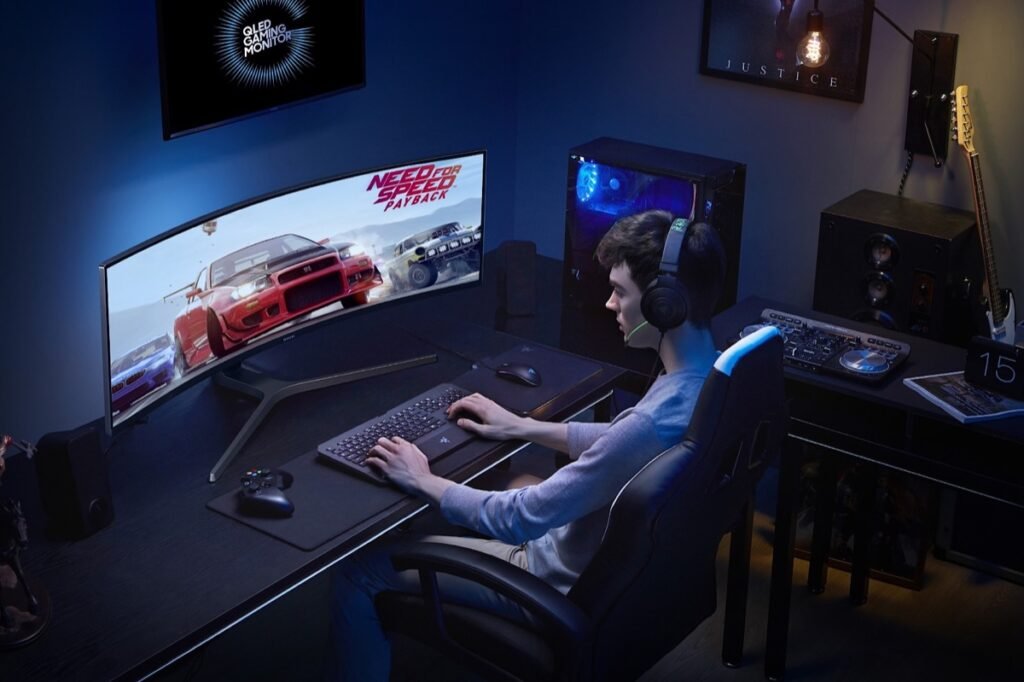
More and more gamers are looking for ultrawide monitors to display a wealth of information simultaneously, because more information means an advantage over their opponents. They are therefore opting for curved screens, which offer several key benefits during video game sessions.
The refresh rate
To get the most out of it and aim for performance, you should choose an extra-large screen with the lowest possible response time and a high refresh rate .
The first determines the latency between the information transmitted by your components and the display on your screen. Ultrawide monitors generally offer a latency of around 5 milliseconds, which is sufficient .
The second characteristic determines the number of images updated per second on your screen. A minimum of 75 Hz is recommended for gaming, but you'll see a huge difference with a 144 Hz PC monitor .
Good to know: If you're looking for a 240Hz PC monitor with an ultrawide screen, you might be disappointed… The best you can find at the moment is a 27-inch screen with the Samsung Odyssey.
You'll also need to consider Nvidia and AMD's G-Sync and FreeSync features. These synchronize your refresh rate with your FPS and are therefore essential to avoid distorted images.
To enjoy a panoramic view!
Another advantage of having an ultrawide screen for gaming is the improved field of view (FOV). Of course, to take advantage of this, one condition must be met: your game must allow for customizable settings. Fortunately, most modern games offer this option. This feature gives FPS players a wider field of view to the sides , allowing them to spot enemies more easily.
In strategy games or MOBAs, you'll have a larger area of the battlefield visible at any given time, perfect for effectively coordinating an attack or spotting troops flanking (attacking from the side). This panoramic view will give you an advantage over your opponents, no matter what game you're playing!
A total immersion!
The third advantage is the immersion so sought after by some gamers to fully immerse themselves in their games. It's obvious that it's easier to feel fully engaged on a 10-inch screen than a 50-inch one, but having the latter as a flat screen won't be any more immersive than a 39-inch curved screen. Curved models are unique in that they are curved at the sides, allowing the viewer to see the entire screen without having to move their eyes . In short, better vision with minimal effort.
Our recommended points in brief for a gaming setup:
- Curved screen
- Minimum refresh rate of 75 Hz
- Maximum 5 milliseconds response time (1 millisecond recommended)
- Integrated G-Sync and/or FreeSync functionality
An ultra-wide screen for working
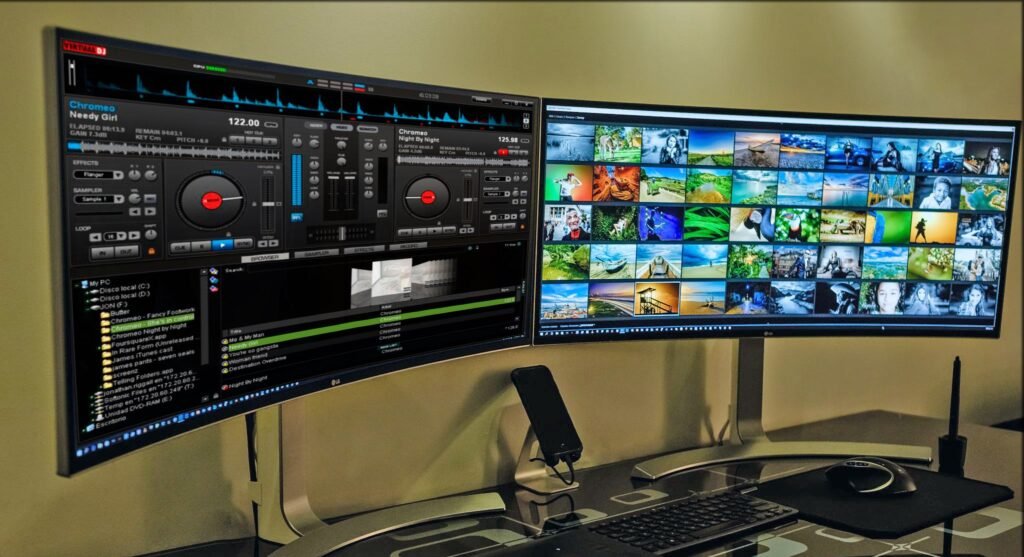
If you want to work more comfortably, a widescreen monitor is the solution you need. Here are a few reasons that should convince you:
Increased comfort and productivity
First, you'll gain in productivity. You'll be able to more easily manage multitasking between your applications, switching between them more quickly. No need to use ALT + TAB; you'll have everything in front of you, all at once . Some manufacturers even offer preset settings to place windows in predetermined locations. These settings are perfect for quickly organizing your workspace. For example, if you're working on a presentation for a company's next financial statement, you can display the PowerPoint presentation, an Excel workbook, and OneNote to have all the information available simultaneously. Even having two windows open will save you time and be more readable than on a small screen.
Stunning resolution and image quality!
You'll get a sharper image resolution . You'll be able to enjoy very high-quality resolution on an ultrawide screen because they have a much higher resolution than smaller screens. While 16:9 screens typically have a resolution around Full HD (1920 x 1080), most ultrawide screens are compatible with a resolution of 3440 x 1440 pixels, which offers significantly higher definition. This resolution refers to the number of pixels the screen has; the more pixels, the more numerous and precise the details will be. This feature is very important for people doing graphic design or video editing.
Improved image quality. Just like pixel resolution, screen quality is very important for image-related professions. To learn more, refer to the following section on "differences in screen quality."
Our key recommendations for an ultrawide monitor dedicated to work:
- A widescreen monitor with minimal bezels if possible, and a window management system
- High image resolution for more detail (consider the refresh rate)
- High image quality
An ultrawide screen for entertainment

Ultrawide screens are also perfect for watching movies or series. If you're looking for this type of screen to enjoy your favorite movies and series alone, as a couple, or with your family, pay attention to these three criteria when making your choice.
Image quality is paramount when watching entertainment. Therefore, consider image resolution to ensure a sharp and detailed picture. Opt for a 4K screen with a high-quality panel .
Good to know : If you're looking for a screen with unparalleled image quality but a smaller size than an ultrawide monitor, a portable 4K monitor will be a great asset! Essential if you need a dual-screen setup for your laptop or for playing console games anywhere!
A 21:9 aspect ratio will eliminate the black bars at the top and bottom when you watch movies shot in a similar format for theatrical release. This black bar effect, called letterboxing, appears on smaller image formats like 16:9 or 4:3 to preserve the original cinematic aspect ratio without distorting or cropping the image.
However, since most series are shot in 16:9, you will probably have black bars on the sides with a 21:9, that's the Pillarbox effect.
Consider the G-Sync and FreeSync functions which can properly synchronize the images and prevent you from seeing 3 movies in one.
Choose your screen with the least bezel possible to make the most of the screen size.
Our recommended points in brief for a screen dedicated to entertainment:
- A 4K screen
- G-Sync or FreeSync functions
- If possible, a small border
Differences in screen quality
There are several acronyms used to describe the quality of an ultrawide monitor. While they indicate the number of pixels , they aren't a complete indicator of image quality, as screen size also plays a role. The smaller the screen, the higher the pixel density, resulting in superior image quality; however, the pixel count is generally adjusted to achieve optimal results. Let's take a look at the different terms.
HD – High Definition
This term refers to a pixel size of 1280 x 720, regardless of the screen size as long as this aspect ratio is maintained. Most smartphones today use HD screens. This resolution is more commonly found on smaller screens.
FHD – Full High Definition
Full HD corresponds to a resolution of 1920 x 1080; this type of resolution is present in a large number of 16:9 screens.
QHD – Quad HD or 2K
Now we're getting into the details, since this term refers to a screen with four times more pixels than an HD screen. QHD screens have a resolution of 2560 x 1440 pixels to provide the viewer with a detailed, and therefore very high-quality, image.
UHD – Ultra HD and 4K
These screens offer even superior image quality. The first has a resolution of 3860 x 2160 pixels and the second of 4096 x 2160. Many of the best 4K ultrawide PC monitors have a resolution of 4096 x 2160, in order to provide the sharpest possible image without the possibility of distinguishing individual pixels.
8K
This is the final stage of definition, which is 16 times higher than the HD standard. With its 7680 x 4320 pixels , the precision is ultra-realistic, and your images will have nothing to hide…
The advantages of a curved screen
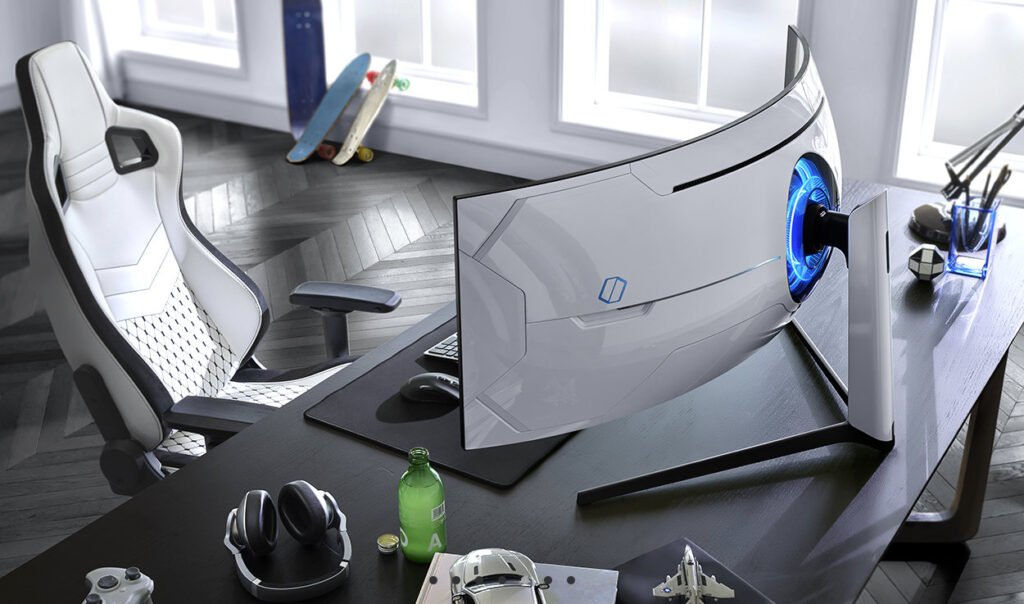
There are several advantages to using a curved screen. Here's an overview:
The curved screen does not distort the image
The wider an ultrawide screen is, the harder it is to see the edges clearly. This reduces visibility and makes it difficult to miss details. A curved screen solves this problem. With its curved design, you can more easily distinguish the edges of your screen because the system automatically adjusts the image based on the viewing angle.
But it's not just the automatic image adjustment that justifies the superior viewing experience offered by curved screens: it's primarily a matter of physics. While light is projected in a straight line onto a flat screen, a curved screen projects light directly towards the viewer. The viewer therefore receives all the images directly in front of them, thus avoiding distortion.
The curved screen is much more immersive
More and more viewers are seeking an immersive experience to fully live and feel what they are seeing. This type of experience has begun to be offered in movie theaters, where larger screens plunged into darkness provide a focused view of what is happening.
With the advent of VR headsets (or Virtual Reality headsets), it's possible to be completely immersed in what you're seeing. Ultrawide curved screens aim to provide this immersive experience by offering viewers an expanded peripheral vision, allowing them to see only what's happening on the screen.
You will feel more immersed in the movies you watch or the video games you play.

The ultrawide curved screen offers a wider field of view
In addition to this immersive experience, curved screens offer a much wider field of view than flat screens. This is because a flat screen of the same size as a curved screen would have distorted edges. Furthermore, your eyes won't have to move from one side to the other to see what's happening, since the optimal field of view covers the entire size of the ultrawide curved screen.
The curved screen is more comfortable for your eyes
With a curved screen, your natural field of vision will be better adapted and will fill the entire screen. To achieve this, you should position yourself at a distance corresponding to the curvature of your screen. For example, if your ultrawide curved screen has a 178° curve, you should position yourself 17.8 cm away from it to optimize your field of vision. It will then occupy the entire width, giving you a complete view of your screen.
Good to know: We invite you to check out our comparison of curved PC monitors to learn more!
Check for G-Sync and FreeSync compatibility
To get the most out of your ultrawide monitor, you'll need at least one of the technologies offered by Nvidia or AMD . G-Sync and FreeSync will allow you to adapt and synchronize the vertically displayed images on your screen.
To use these features, you'll need a graphics card from one of the manufacturers; otherwise, this functionality will be useless. The first thing to check is whether your monitor is compatible with your graphics card , or vice versa. With that said, let's look at the advantages of these features.
Prevents Tearing
Screen tearing is a problem that occurs when the number of frames per second (FPS) calculated by the graphics card is not synchronized with, or a multiple of, your monitor's refresh rate (Hz). This results in the display of multiple images that are not synchronized in time and space.
Taking the example of a football match during a goalkeeper's clearance, the top part of the screen will display the corner stands of the stadium, the middle part the center circle of the pitch, and the bottom part between the penalty area and the center circle. It's difficult to follow a match under these conditions… G-Sync and FreeSync, on the other hand, prevent these image glitches by synchronizing the monitor's refresh rate with the frame rate.
Adapts against Stuttering
This synchronization goes even further, as it can adapt depending on the game you're playing. Stuttering refers to micro-stutters of images that are duplicated to continuously display them on the screen. When viewing a screen affected by stuttering, you'll experience a sensation of choppy images and therefore an impression of lag. To solve this problem, G-Sync and FreeSync automatically adjust their refresh rate to that of the GPU.
This process will occur when your game demands too many resources from your gaming PC to achieve the required frame rate (FPS) at your ultrawide monitor's refresh rate. The monitor will then lower its refresh rate to match the FPS and thus display the images correctly.
Additional options
Many monitor manufacturers offer users additional features to personalize their experience. These options are specific to the brand or product line. Indeed, a high-end ultrawide monitor will have more features than a low-end one. Here are some examples of the additional options offered by manufacturers.
Built-in adjustment programs
Programs are installed to adjust every detail, such as colors, brightness, contrast, and even speaker volume. Some even offer configurable profiles that will launch depending on the application being used. This option is particularly useful if you have chosen different settings for watching a movie and playing your favorite game.
Ultrawide screens are replacing dual monitors, which are generally used for multitasking. For example, writing code on one screen and viewing the results on the other. Programs offer quick and easy management for this type of display, where you simply select a window layout on your screen: two windows side-by-side, two windows stacked on top of each other, three windows with one large window at the top and two smaller ones at the bottom, etc.
Comfort options
To improve user comfort, manufacturers are integrating dedicated settings into their screens. This is particularly true of the Samsung S24F350FHU ultrawide monitor, which incorporates energy-saving technology and a display mode that reduces blue light. The former automatically adjusts the screen's brightness based on the ambient light. It will lower the brightness if darkness is detected to avoid glare and consequently reduce energy consumption.
According to Samsung, it can be reduced by 10% with this automatic function but by 50% with manual settings. The second integrated setting is Eye Saver mode, which reduces blue light emission to offer greater comfort and less eye strain.
FAQ—Discover all the details about Ultrawide screens
What are the differences between a 100Hz, 144Hz and 240Hz screen?
Hz refers to the image refresh rate (or frequency). The higher this rate, the smoother and more comfortable your image will be to watch because your screen will scan more frequently. It is closely related to frames per second, but the difference is that it will sometimes also display the same images again to ensure they align with previous ones.
A frequency of 100 Hz is sufficient to play your favorite games, given that 75 Hz is the minimum recommended frequency.
A 144Hz monitor will already make a huge difference when you're watching it. Your experience will be much smoother than on a 100Hz monitor, and you'll be able to play with complete peace of mind. This refresh rate is generally chosen by demanding gamers to enjoy more resource-intensive games.
Finally, a 240Hz monitor will push all boundaries. Designed exclusively for gamers who refuse to compromise on their gaming experience, monitors with this refresh rate offer near-realistic fluidity. If you choose this type of monitor, your system needs to be able to handle it.
Why buy an ultrawide screen?
It's sometimes said that size doesn't matter, but an exception can be made with ultrawide monitors. If you want to play with high resolution and total immersion, ultrawide monitors are for you. Similarly, if you're a professional and need high-end equipment, you'll gain productivity with this type of monitor.
are the most common and comfortable . With an 86 cm diagonal screen, you'll have plenty of room to do what you like. However, if that doesn't seem sufficient, and if you have the space, you can accommodate a 49-inch monitor on your desk, boasting a gigantic 124 cm diagonal screen. Enough to impress your guests, if you still entertain them with such a gem.
How important is the response rate?
Response time is very important because it defines your screen's reaction speed, that is, how quickly a pixel changes color. Response times are generally around 4 to 5 milliseconds, but can be as low as 1 millisecond on some screens. The lower the response time, the smoother the displayed images will appear .
What is HDR?
HDR, or High Dynamic Range, was once used exclusively in photography. It's a technology that allows for greater brightness with better contrast. Indeed, an HDR screen will be able to process not only greater brightness but also deeper blacks.
Regardless of the image exposure, HDR will be able to display particularly bright areas in detail and delineate shadow areas in order to get as close as possible to human vision.
For an optimal minimum experience, we recommend opting for an ultrawide screen with a brightness of at least 1000 nits and less than 0.03 nits for black.